Monday, November 21, 2005

Brainwashing

Somehow, by force of personality perhaps, I have converted Bogi to football. I suspect this is the kind of stepfatherly bequest that she may end up needing therapy to get over. Over the last few weeks she has started finding football matches on TV and inviting me to watch them with her. Since there is practically always a football match on TV in Romania at any one time this is not hard to do. However, by helping her with her selectivity we have focussed our attention on the Spanish Primera Liga mostly, while typically avoiding the Romanian league (though we do do internationals too).

Her favourite player is Ronaldinho, so we watch every Barcelona game. He is a good player to be into, partly because he’s bloody brilliant, partly because he is easy to recognise from a distance, and partly because he sees a lot of the ball so her interest doesn’t wane. Yesterday, while we were watching Celta Vigo vs Atletico Madrid (we were both supporting Celta, though sometimes we choose opposing teams just to spice things up), she started asking whether the team would get an “eleven”. I thought she was talking about the number of players on the team, but then finally worked out (with Erika’s help) that an eleven in Hungarian is a penalty. She also started telling me the rules – at one point someone got booked and when he saw the yellow card she excitedly told me in her Hunglish: “The red card is very very rossz” (bad). I was forced to agree. A little later she even told me that “two yellow card is making red”. I have no idea where she gets it all from – school I suppose – but it’s great. Trying to explain the offside rule to a six year old though is a challenge, especially when you have to relate to each other in pidgin versions of each other's language.

Also (and this is definitely classifiable as child abuse) she has got into helping me follow Sheffield Wednesday via the Internet, constantly checking and rechecking the scoreline on one of the websites dedicated to that purpose. The other day a couple of weeks ago, we (Wednesday) were playing Cardiff and she was insisted when she went to bed that the first thing I did in the morning would be to tell her the final score. Sadly we were hammered, so I waited until later in the day so as not to shatter her day in the way my evening had been shattered, as so many before it. Fortunately she is not quite yet so obsessive to actually remember when she wakes up that she wanted to know the score (or even to be bothered for more than 10 seconds). I'll give her about two more months.

Conceptual Hungary

Hungarian, as you may or may not be aware, has all these cases. No, not suitcases, linguistic cases. In practice, to someone like me who has never previously tried to learn such a language, this means that there are a bunch of suffixes to learn which can be appended to nouns or adjectives.

So far so good. I will skip over the concept of "vowel harmony" which is a truce declared after the Great Diphthong War of 1293 and still holding to this day, because while it is interesting, it's not what I want to comment upon today.

What I want to comment upon today is the idea of being in or on something. I am sure that the relevant case for this concept has a name like the plaintive case or restive case or something, but I don't know what it is, and I can't really see the value in learning it. What I need, as a student of the language, is to know that to express what English uses the preposition "in" for, one needs the suffix -ben or -ban (depending on vowel harmony, but we're not talking about that). With me so far? Now, if you are in a particular country, say, you may use this suffix to express that. Angliában, for example, means "in England". You can do this over and over: Romaniában, Spanyolorszagban (in Spain), Amerikában, etc etc. It works for every single country in the world bar one. Hungary. For some unaccountable reason you cannot be "in" Hungary, but you can only be "on" it. So you have to say Magyarorszagon. Maybe Hungary is a concept, an indeal, that can only ever be grasped at but can never be entered.

Not only that, but it works for cities too. Londonban, for example, but Budapesten. I think, but am by no means sure, that you can only be "on" most cities in Hungary, and a few others (in Cluj, for example, is actually Kolozsvaron rather than Kolozsvarban). To confuse me even further, while everyone here says Csikszeredában, often on the Duna TV channel (from Hungary, but with lots of Transylvania based news) they often say Csikszeredán.

It's a rum do, that's for sure.

PS I am well aware that English is not in any way whatsoever logical, and while you welcome to comment on how ridiculous my native language is, you will receive nothing but agreement from me. Please take it as read.

PPS. I am sure that my vowels are disharmonious at times. Feel free to taunt me.

Sunday, November 20, 2005

What? Hó.

Winter started on Friday afternoon. We were told it would, and the forecasters were right. At about 2.45PM the snow began to fall, and it kept on falling. By 6PM I had participated in my first snowball fight of the season (Bogi insisted I was “cheating” – which seemed to mean that my snowballs were actually on target, even from distance, though she probably didn’t know that they were even more on target than that being aimed at non sensitive areas which were well padded by multiple layers of clothing).

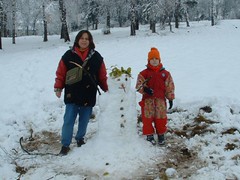
When we woke up on Saturday we were greeted by the scene on the picture below, with the snow still falling. Most years in snowy climes you get prepared for winter by having off and on flurries for a few weeks before the first big snowfall. Not here. Bang. One morning you wake up and it’s still autumn and a positively balmy 5°C, the next, and you’re digging out your car from 30cm of snow.

So we went out and threw more snowballs, and built a snowman, and generally had fun. I like snow and real winters, I just wish they’d only last for about three months. Three months of winter is perfect. 6 months not so perfect. But I will resolve to live in the moment and enjoy the three months of winter between now and February 19th, before settling into my moaning bitter old man persona for the remaining two months or so of it.

Oh, and the title? “Hó” is Hungarian for snow. I know, even by the appallingly low standards of this blog, that pun is seriously scraping the barrel, but just be grateful I didn’t tap into Gangsta Rap for my ho-related pun inspiration.

View from our balcony Saturday morning.  Posted by Picasa


The three of us
Originally uploaded by adhock.

I'm the one in the middle, in case you were wondering.


A couple more pics are here.

Thursday, November 17, 2005

Satisfaction

Very few people know about my clandestine and rarely fulfilled decadent indulgence. This is not an indulgence that is little known for reasons of me being secretive about it, more that it is one that I tend to only indulge in the privacy of my own home, and so is not often brought into the public gaze. It is also closely affiliated with my home country and a luxury which I have not previously been able to pursue elsewhere. That is until now.

Because of this momentous event I have decided to go public, to come out and share with the world my sybaritic debauchery.

I am talking, of course, about pickled onions. Real pickled onions, not those small ones that people sometimes put in martinis. No - big fat ones dripping with vinegar and as acidic as the world's most sarcastic person. You bite into them with that satisfying crunch and let the sting of the vinegar and the brute force of the onion take the skin off your tongue. It is a beautiful and sensual moment.

But it's a rarely enjoyed moment, because for reasons only known to the rest of the world, the pickled onion has not travelled well, and like the digestive biscuit, appears on foreign shores only in odd, dusty little shops run by British expats who are sure that if they import enough tea bags they will make a tidy profit.

Well, for the first time, I have made some. And, I'm happy to report that they are everything I expected and more. Crisp like a February morning, sharp like a hypodermic, acid like a field of tripping people. And I suspect they will only get better with time. I had to leave them to fully infuse for six whole weeks after making them, and then I left them for one whole more week just because I was scared they would be no good and I'd be disppointed. But they are good. Damned good. The remaining jars I may keep as some kind of special occasion reward to myself, and see if they get even more potent. I am happy.

Now if I could just brew up a decent pint of Marston's Pedigree, the world would be a wonderful place.

Tuesday, November 15, 2005

The minority law and the far right

The political scene in Romania is currently gripped by the debate over the minority law. It’s difficult to find English language sources regarding this debate but I think it’s worth looking at anyway. What follows is what I’ve been able to glean about this debate from my limited Romanian and Hungarian and from talking to people. If there are any inaccuracies, I hope someone will please correct me via the comments page.

From what I understand, there is a bill before parliament to enshrine in law basic rights for minorities. It’s not that these rights don’t already exist in practice, but that they are not formally stated anywhere [Edit: Note comments from Andrei below]. This bill is proposed by the UDMR which is the Hungarian party in the Romanian parliament. [The UDMR is a fairly moderate centre right party politically, but its main function is to represent the interests of the Hungarian minority in Romania.] Because of the political makeup of the parliament, the UDMR are almost always a partner in whatever coalition government is ruling, and one condition of their joining the government is that they get to put this bill before parliament. So this isn’t the first time it’s come up, but each time it does, it seems like the dominant coalition partner (whether this be the DA as now, or the PSD as before) renege on the deal and start trying to weasel out of it.

So now it’s come up again. What amounts to a fairly watered down version of the original bill is up before parliament and it is being attacked left, right, and centre. Mostly, of course, by the ultra right, for whom minority rights are anathema. Cornelius Vadim Tudor, the ultra scumbag leader of the ultra rightist Party of the Romanian Nightmare (not actually the real name of the party), is pulling out all the stops to fill the population with fear of this terrifying Hungarian minority. Apparently this law will subject Romanians to oppression by those evil Hungarians. It’s an old trick – white supremacists argue that laws promoting diversity and human rights are actually laws designed to attack white people. So it is with Vadim Tudor. Vadim Tudor is the worst kind of bigot – he’s actually quite intelligent I think and he knows this fear-laden rhetoric is the way to mobilise people to support him. So, he whips people into a nationalistic fervour by claiming that the minorities are out to attack their right to exist and to be Romanian or something. In a recent debate he said, and I swear I’m not making this up “Do you really want Romanians to defend themselves alone? They will! I promise you things will go that far!” That’s practically inciting civil war, and he gets away with that shit, and not only that, but they give him vast amounts of air time on TV. He is utter utter scum. He also described the UDMR as a “terrorist organization”, just to really ratchet up the fear factor among his rural uneducated voting public.

Now, if it were just him attacking the bill, it wouldn’t be a surprise at all, but in fact the supposedly left wing PSD have also seized upon his coat tails for a spot of populist bigotry and have launched into the debate. I didn’t have any respect for them before, but now what little hope I held out for this bunch has gone right out the window. Also members of the DA (the dominant part of the coalition) have been speaking up against it, which means probably that it’s dead in the water. The media here are focussing on what this means for the government and whether the UDMR will pull out of the coalition and bring down the government, forcing early elections. But this is not the real issue (it just allows people to not think about the real issue).

What then, is the real issue? The debate around the bill seems to be centred on the phrase “cultural autonomy”, which, as far as I can tell, allows minorities the right to have an education in their native language and so on. In the case of Hungarians, at least, this already happens (at least up to age 18). What the anti camp are really against, I suspect, is the word “autonomy” featuring anywhere in any document ever. This bill does not, categorically, request any kind for autonomy for Harghita and Covasna counties, nor for Transylvania as a whole. But, the people against it like to present it as the thin end of the wedge and the beginning of this Hungarian master plan to break Transylvania (or parts of it) away from Romania. And of course they then hold up the example of these poor oppressed Romanians living in Harghita and Covasna counties who are already suffering mightily at the hands of these brutal Magyars, and if this master plan comes to fruition will be somehow oppressed and magyarised as they were at the end of the 19th century.

The other issue is language. Now it seems that many Romanians are convinced that Transylvanian Hungarians cannot and will not speak Romanian. I don’t know where they get this idea from, but it seems to have a lot of currency, even among well educated Romanians. Now, it is possible, that in remote villages people don’t speak Romanian well, or in some cases maybe at all. But Romanian is taught in schools, kids need to pass their Romanian exams to get through the various general exams and to leave high school with a qualification. I can honestly say I don’t know and have never met any Romanian citizen who doesn’t speak Romanian. Maybe they’re not all completely fluent and maybe they have an accent, but they speak the language. What seems to upset people is that, shockingly, they persist in speaking to one another in their native language. People who are otherwise quite intelligent have asked me whether this is “normal”. Whether it’s normal that people speak their first language to each other. I have to respond that yes it is, and to deny the people the right to use their native language is characteristic of dictatorships and oppressive regimes. And to offer people an education in their native language in their home country is not in some way weird or anti-patriotic whatever it is they fear. Democratic Spain for example offers Catalans and Basques the right to an education in their native language, while under Franco there were attempts to ban the languages outright. Which of these two governments is more modern and “European”? (I ought to note that one of the bizarrest arguments against the minority law is that it is “un-European”). The only thing that I can possibly imagine is that in the twisted political climate of fear and insecurity brought about by the posturing of idiots like Vadim Tudor, when people hear a conversation conducted by Hungarian Romanians in Hungarian they assume it to be some kind of plotting against the state.

To close, I have to say that listening to the rhetoric of the ultra nationalist PRM, while knowing that they command about 12-13% of recent polls, is the first time since I came here that I have wondered if just maybe there could be some kind of mini civil war in Transylvania. My hope is that the majority of the supporters of CVT and his ilk are actually not from Transylvania and in fact live in isolated rural communities in Oltenia and the like where they can’t do any damage. But this kind of hard line talk of terrorism and of Romanians “defending themselves” is just the kind of thing that Milosevic was saying in 1989. Fortunately, CVT doesn’t have the power that Milosevic did then, but it’s a slippery slope and as long as he’s given a platform to air his odious views, the damage is being done.

Monday, November 14, 2005

Coming out in a nasty 'tache

Why is it that Hungarian men sport large moustaches unseen practically anywhere else in the world? Is it to disguise spectacularly ugly upper lips? Is it like a clown's makeup - you can tell whether the man in question likes to think of himself as happy or sad depending on whether he's gone for the uplifted twirly version or the downcast drooping down to the chin version?

It's most odd. It's not everyone, obviously. I know of many many clean shaven men both here and in Budapest, but this long moustache thing does seem to be a curiosity of the Magyar male. Having said that I just did a bit of research - to be honest I typed "Hungarian moustache" into google, which is what passes for "research" when I am feeling lazy - and found that in Europe this kind of moustache is actually called the Hungarian Moustache, while in the US it's called the "Wild West Moustache". Which leads me to suspect it's related to horsemanship and riding across endless plains herding livestock. But why would horsemen need long bushy moustaches? The other possibility is that it is related to the concept of the "Gay Hussar" - is the moustache seen as an identifier within homosexual culture because of it's links to Hungarian men and hence to the Hussar and ... well you can see where I'm going with this, but I fear that I'm barking up the wrong leather clad thigh.

It's a fascinating subject I think you can tell, and I am inspired to look into it further. Though I'll probably forget.

Saturday, November 12, 2005

Say hello, wave goodbye

Been away from these pages for a few days, in part taking care of my latest bureaucratic need. I can’t go into details just yet, but I can inform you, my loyal reader, that it involved both a visit to the British Embassy and a chest X-ray. At that, it will have to wait for now. You may, if you like, see if you can possible imagine what level of bureaucratic procedure might involve those two necessities.

Not much to add to that at this stage, except to note that in updates to recent posts – (1) the teachers’ sztrajk is still on; (2) despite chaos theory, the storks were able to predict weather 3 months in advance and we are still enjoying a glorious autumn – last Sunday we were walking around the town in T-shirts. In November. I’m told this is unheard of in Csikszereda; and (3) after the first half of the regular season in the ice hockey, SCMC are still unbeaten (we beat Steaua 4-2 in one game and drew 3-3 in the other, both games in front of half a dozen cheerleaders and no-one else. Bucharest people just don’t give a shit about this sport I reckon. We already deserve it more)

Weird things Hungarians do: Say hello when they mean goodbye. And by hello I mean the actual word “hello”. It stops me in my tracks every time I leaving somewhere and as the door closes behind me someone waves and says “hello”. And by now I should be totally used to it. I’m guessing (and it is only a guess) that sometime in the past the word hello became fashionable in Hungarian speaking regions, and it was understood to be a friendly greeting. However, the Hungarian friendly greeting words “Szia” and “Szervusz” are also used for friendly farewells (as per ciao, aloha, etc), and so it was assumed that hello was synonymous with these words. Quite understandable and easy to rationalise, but I defy any native English speaker to get past the cognitive dissonance brought on by hearing someone say “hello” as they (or you) leave.

Monday, November 07, 2005

Sztrajk

What, you may be thinking, is that? (Unless you speak Hungarian that is). Well, that word in the title is actually one of the few Hungarian words which is a cognate with English (and indeed, I assume, must have its roots in the English word). It may look weird but when you sound it out phonetically (and you can do that with Hungarian unlike English) it spells "strike".

So, this week in Romania the teachers are on sztrajk. In Bogi's kidergarten, in the elementary schools, in the high schools and in any other form of state run education (except possibly universities, I dunno about them), the teachers have walked out in protest at underfunding (of education in general and of their salaries in particular). Indeed so serious is this underfunding that the minister of education quit a few weeks ago, after not being able to get the government to stump up a greater proportion of the national budget to his portfolio. (I don't know much about this minister, but this act seems to me to have been spectacularly honest and oozing with integrity. Very unpoliticianlike in fact).

Right now all the schools are closed, but apparently by the end of the week the sztrajk may have become a "Japanese Strike", which apparently means a strike in which everyone wears a badge saying they're on strike but they actually still go to work. It sounds entirely baffling to me, and as a method of industrial action it doesn't sound very effective, but I do know that teaching tends to be one of those professions where the staff are extremely reluctant to go on strike since they are worried about "punishing" the recipients of their services - ie, in this case the children (see also nurses, firemen, etc), so this "Japanese Strike" thing is presumably a way around that. I also have absolutely no idea why it's called a Japanese Strike.

Other possible strike actions:

Mexican strike: people get up walk out in waves as you go along the corridors, then go back and sit down again, before doing it all over again when the wave gets back to them.

Brazilian strike: everyone walks out and goes off to get their pubes waxed

Child strike: small three-wheeled bicycle.

Sunday, November 06, 2005

Copsa Mica

On the train between Cluj and Sighisoara you pass through some great scenery, rolling hills, the Turda gorge (no sniggering), valleys, woods, saxon towns and villages. But you also pass through Copsa Mica. Copsa Mica is everything you might have imagined of industrial Eastern Europe from those images of vast pollution we saw after the revolutions of 89. It’s dominated by these vast empty run down factories and worker dormitories that seem to stretch for miles. Back in the day it was so black that even the white bits were black. No, I’m serious. The snow was black up until 1995. There are are
two satellite photos, here
which show how the area looked from above in the 80s and now (after it’s been cleaned up a bit).

Even though the town is no longer black, though, it is still horribly polluted as the second factory there (the blackening one made tyres and dye) made chemicals and filled the ground with dangerous metals, which are still polluting the river and the water table and all vegetables grown there. A lot of people who live there are very very sick (and also very very poor as the factories got closed down). There’s a good overview of the situation at this website

Friday, November 04, 2005

Eight down, one to go

It's getting closer and closer to the big day. This was brought home to me yesterday when we went to the doctor and he said not to bother coming back until we were in labour. But then I expounded my views on Tony Blair and how that wasn't about to happen and he let us off. Ha ha. No but seriously, it'll be in the first half of December (probably), and as it's now the first half of November (certainly) that means it's very soon.

Suddenly I have become aware that my usual method of planning (cross every bridge when you come to it) may not be a terriby good idea in this case. It would probably, for example, be a good idea to have somewhere for the little lass to sleep when she gets here. She might need clothes and stuff too. And really, I can't just take care of this when she's shows up. If I still lived n the US someone would have thrown us a baby shower (no, I have no idea why it's called a shower either) and we'd have a house full of useful and less useful items, but here in Europe, while we may have easily available espresso coffee and a less rigid work ethic, the day of the shower is not upon us. (Why we import such concepts as trick or treat, and not the more useful ones as this is beyond me).

Mind you, we saw nice pictures of her and she doesn't look as csunya* as she did last time. (Csunya = ugly, and to be fair neither me nor Erika thought she was csunya last time either, but Bogi was quite sure of it. Now, even she is convinced of the possibility that her sister will not be some blobby foetal thing with indistinct facial features).