Wednesday, September 12, 2007

Seven Hills

(Apparently this blog has been locked by "spam prevention robots". I always thought there was a niche in the kids TV market for an avenging army of Transformers type vigilantes going round trashing supermarkets who dared to sell processed meat in cans. No idea when this post will get published in the meantime)

I have more of my holiday experience to post on, but am just back from a short work trip to Iasi in the east of Romania, and needed to let any readers out there know that I have discovered a truly excellent Romanian beer. This is not to say that some of the better Romanian beers (Ciuc, Ursus, Silva dark, etc) are bad, but they're not excellent exactly. They're just reasonably good quality fizzy lagers, not much to write home about. But in Iasi I was introduced to a stunningly good beer. It's called Sapte Coline (7 hills). It's unfiltered and unpasteurised and really it compares well to some of the good Belgian beers. It also comes in extremely cool bottles. Here's their website.

There is, of course, a catch. 7 Coline is only available in certain restaurants and pubs (no shops) and only in Iasi (at least this is what my Iasish hosts told me). I hereby start a campaign for wider distribution of what is by far and away Romania's best beer. I hope you join me, and if not, that you make the trip to Iasi to sample this amazing find.

Wednesday, September 05, 2007

Brela

So, Brela

Gorgeous. Crystal clear water, warm sunny days, no throngs of tourists, and more importantly no throngs of touristy shops full of things that Bogi would spend all day every day coveting. I'd recommend it to anyone - and the nice thing is that because of it's topography it's never likely to get any more crowded than it already is. The town's website.

The apartment we stayed in was pretty well situated, only about 100 steps from the beach (and by steps I mean here steps as in stairs - it is a hilly place), whereas most others we saw were well over 300 steps up and down. In fact I did one day count the steps and there were exactly 101, which meant that they constituted 101 Dalmatian Steps.

The beaches are superb - not sandy, but the water is just exactly right for swimming and especially for kids, shelving gradually, clean and warm and clear and salty enough to hold you up but not sting your eyes. Apparently they have won some prestigious Euro "blue flag" award which means nothing to me but they seem inordinately proud of it. I was also told that Brela beach once appeared in a list of the top ten beaches of the world in Forbes magazine (it must have been a slow news week in the world of rapacious capitalism), and was the only one in that list in Europe. I can't actually verify that fact but it does seem to be repeated at a number of Internet sites (which doesn't of course make it true). This is the most convincing page featuring that information. Though having looked at that list I would take some issue with it, given that I have visited about 5 of them, and they are in a very weird order. I'd like to know what the criteria were.

To finish, as is traditional when I go somewhere, name five famous Croatians, and while you think, so as not to have my answers give the game away, here are some pictures:This rock is the symbol of Brela. if you look closely you can see that there is a little notice on it. The notice indicates that dogs are not allowed. It is not clear how a dog is actually supposed to get on to it in the first place. The only explanation is that the notice actually means "Do not throw your dogs on to this island"


5 Croatians: Davor Suker, Ante Gotovina*, Goran Ivanisevic, Franjo Tudjman, Tito.

*It's obviously a bit risky mentioning Gotovina's name, since there are people out there lurking ready to misinterpret any use of his name in the category of "famous Croatians" as meaning that I hold him personally responsible for the deaths of 2 million Serbs. However, I do feel at liberty to express the opinion that Franjo Tudjman was an arsehole. And I wish he'd gone to the Hague.

Monday, September 03, 2007

Banana Split

...Part 2, of the epic drive around the Balkans (is it? Where do these mysterious Balkans begin and end? I have a feeling we kind of circled them, but am not really sure because I'm not really sure where they begin and end - and why they are a they at all, since as I understand it, "they" is a peninsula)

The next morning we awoke to find that Törökszentmiklós actually had residents and wasn't in fact some bizarre ghost town. They were up and about and shopping and going about their obviously diurnal existences. Perhaps there had been an air-raid the previous evening that had made them enforce a blackout and had them all huddling silently in their bomb shelters. We shall never know, since we packed up and shipped out sharpish.

We had decided that rather than traversing Hungary by motorway, we would (as we had given ourselves enough time) see a bit of the country, and so head off in a vaguely south western direction. There really wasn't much to see to be honest, at least east of the Danube, as the countryside was unremittingly flat and uninspiring and the towns not really much better. The one thing you have to be a bit careful of when driving across Hungary from East to West (or from West to East, obviously) is to make sure you plan where you are going to cross the Danube. If your itinerary takes in Budapest obviously you can do it there, but otherwise you have to be fairly careful as there really aren't that many bridges. We elected (in advance, thankfully, so we didn't have to back track and keep banging up against a wide and uncrossable watery barrier) to cross at a town called Dunaföldvár, which was a pleasant little place dominated by it's bridge (obviously), and having a very bridge-based sense of identity - in the town square there is a statue of two blokes surveying which is not something you normally see in statues (Everywhere it seems, but in Hungary particularly, statues are very keen on involving horses).
The surveyors of Dunafoldvar

We stopped for lunch under the watchful gaze of the lifeless team of surveyors, and then continued on. This time with added contours - the landscape west of the Danube is much more appealing. Sadly we didn't head south for Paks (birthplace of one of my favourite Hungarian slang expressions - as reported here) or even Pecs, a town which I really would love to see, as it has the reputation as Hungary's most interesting/beautiful town. Finally we fetched up in Nagykanizsa, which is fairly close to the border, and since there was an intense rainstorm going on, found a place to stay. This proved much easier than it had been the night before, as there were people and lights and life in Nagykanizsa (despite the downpour).

The next day we were up early for the long drive to the coast, this one to be more or less all on motorways, so while it would be the longest day in terms of kilometres, it promised to be the shortest in terms of hours and minutes. Another day, another border, this time leaving the glorious free market of happiness and prosperity that is the EU. Would we have difficulties? Would the Croatian border police, venting their frustration at Romania's accession without them, pick a fight and drag us aside to be questioned at length? No, we were waved through in seconds (though the bloke was ridiculously surly) and then even handed a series of tourist information leaflets and maps of the country. This is a service I have never received before. Free maps! What a brilliant idea. I was instantly well disposed towards this country (leaving the country a week later was a different story, but I'll leave that for now).

We hared down the motorway towards Zagreb, eating up the kilometres in a way unheard of in our motorway free world. You don't get to enjoy the landscape in the same way by this method, but you do get to your destination a lot faster. We slipped past the capital and were then off and running towards the coast, on what must be one of the world's most international motorways. I'd reckon about 25% of the cars on the road were Croatian, and the rest were from all over Europe - In rough order of volume Austrians, Hungarians, Slovenes, Germans, Czechs, Italians, Slovaks, Bosnians, Poles, Romanians, Dutch, French, Belgians, Brits, and Russians. I had thought we had travelled an unfeasibly long way to get to this coast, but passing or being passed by Poles and Belgians, made me realise that we'd barely even had to get out of bed.

Another thing to note about this motorway is that my brother built it. On his own. Armed only with a spoon and a trowel. In four months. He's good at stuff like that, my brother. OK, he didn't actually build all of it, just some of it, and he had some help I think. But he was (at least temporarily) involved, and I even went to stay with him in the small town of Ogulin back when he was doing so. That town, indeed, was my first introduction to the concept of pizza with ketchup - something which I rediscovered (to my horror) when I got to Romania. Anyway, he did a good job did my bro' as this motorway is a pretty spectacular piece of engineering work, involving numerous tunnels (two of which clock in at at approximately 6kms long), and long stretches on concrete stilts along the sides of cliffs ("stilts" may be the wrong word there, but I don't know what is. Columns? Pillars? Girders?). Aside from the fact that this motorway was entirely the work of one of my family members, it did beg the question as to how come Croatia has managed to install this very fine infrastructurial artery to serve the country (and it's by no means the only one - there are more of them to the various corners of that banana shaped country) while Romania, member of the EU and all that, has managed so far to build a short one from Bucharest to noted population and tourism hub Pitesti and very recently one that nearly goes to the coast. Transylvania and Moldavia don't have a centimetre of motorway in them. It's a bit pathetic really.

Anyway we zipped south, and waved goodbye to the long queue of traffic exiting at Zadar, while we headed on towards Split. (The town immortalised in the classic "Theme from the Hair Bear Bunch" - "So don't yell, Help! Help! Here come the bears, Lets split!").

One odd thing as you head down the coast on the motorway, is that you basically never see the sea. This, it turns out, is because Croatia's coast is very mountainous and the road is built one ridge back from the sea. This is something we discovered to our cost when we finally reached the end of the motorway, which has conveniently been constructed to a point about 15kms from Brela, our destination. Or at least we thought. Sadly, though, the road between the motorway and the coast had been temporarily closed and we were forced onto a diversion of epic proportions, having to head south around a massive mountain before being able to cut back to the coast and back up to Brela - a 100km, 2 hour plus journey which I really didn't need at that juncture. My father in law enjoyed it immensely, getting to see tiny dusty Croatian villages and all that, but I just fancied a break from driving. On this unexpected tour of out-of-the-way villages we did also get to see a poster proclaiming Ante Gotovina a hero, which reminded me of the reason why Croatia isn't yet in the EU while much less developed (at least to the naked eye) Romania is. (though to be fair, it's not like Romania doesn't have it's fair share of powerful people who probably ought to be arrested and tried for stuff they did in the past. Yes, Domnul Iliescu, I'm looking at you)

Finally, though, we made it to Brela, our destination. Total distance from Csikszereda - 1600km on the nose. 1000 miles for those who still use them. I sank a well earned beer or five, and we headed straight down to the beach to cool off. Rave review follows tomorrow in the next instalment of this enthralling "what I did on my holidays" style essay.

Sunday, September 02, 2007

I would drive 500 miles

and I would drive 500 more...

Friends from Budapest had booked their holidays in Brela, Croatia, and suggested that we join them. Having finally obtained a reasonably sized car for such an undertaking (a Daewoo Tico really isn't suitable for a family of four and luggage to make such a trip), we said yes, and I started looking on the excellent ViaMichelin website for the route we should take. The shortest distance involved driving to Timisoara, down to Belgrade, and then across Bosnia to the coast, but this wasn't necessarily the quickest, which instead involved utilising those miraculous things called motorways (unavailable in Romania, Serbia, and Bosnia) to make the trip through Hungary and Croatia. Since we had also decided to bring my father-in-law, we thus chose the quicker route (especially because we would have to first call in at Marosvasarhely/Targu Mures to pick up our passenger). In the spirit of the age in which words are combined to make other more ridiculous and crap sounding words (like "infotainment" or "synergy") here is my contribution to the new vocabulary: a narradrive. Enticing huh? Read on...

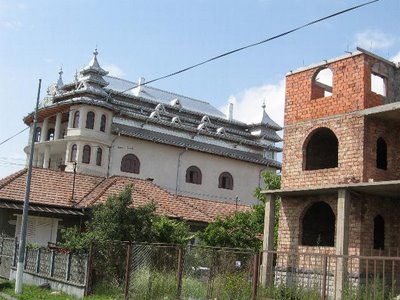
After the pick up, on the well worn route through Hungarian speaking Harghita and Mures counties, we set off towards Cluj. En route ( a road I have driven a few times) you pass the most amazing houses in Campia Turzii. I don't have a picture to share, but here is a similar one in Huedin (which we also passed later)
(courtesy of Dumneazu's excellent blog).

These are houses built by rich Roma, and the ones in Campia Turzii are, if anything, even more exotic and overwhelming than the one pictured above. Next time I pass them, I will definitely stop and take pictures. (Later update: Please see comments to this post for Randy's link to a photo of the houses)

We descended into Cluj - however you approach Cluj you have to seemingly descend into this large hole that the city seems to be built in. From the south the descent is particularly dramatic, but every other way seems to involve a similarly precipitous descent (I've never actually flown to Cluj, but I'm making an educated guess that the same would be true in that direction too). One thing you pass as you engine-brake your way down the mountain is a huge sign by the side of the road welcoming you to the city. This welcome is conducted in many different languages - Romanian, English, German, French, Arabic, Hebrew, Japanese etc. Only one language (given Cluj's history and ethnic mix) is conspicuous by its absence. Yes, you guessed it, Hungarian. This sign is, I strongly suspect, a cheery reminder of the Funar years when Cluj was presided over by a lunatic Romanian nationalist mayor who did everything he could to piss off Hungarians, but instead, unsurprisingly, ended up looking like a petty minded idiot.

Through a very congested and chaotic Cluj, passing straight through Romania's most beautiful suburb, a horrible mess of a place which is, I think, called Manastur. I've only ever really been to central Cluj before, which is quite nice, but Manastur is about as horrible as it is possible to be. We then climbed back out of the city on the road to Oradea (and Huedin, see above). This is a road I hadn't driven before, and it is (in places) very attractive, especially when it climbs to the top of a mountain pass just past Negreni.

Finally we made it to the border at Bors, just past Oradea, and crossed with incredible ease, our first time crossing a land border since Romania joined the EU. A brief look at our passports, and we were waved ahead. No checking of the car papers, no checking of whether or not the Romanian passport holders had 500 Euros each (as they used to have prove), no problems. Miraculous. We stopped off for a coffee, at which my father-in-law told us how the first time he'd ever crossed this border sometime back in the 60s, the first thing he and his friend had done was to drink a coffee since real coffee was at that time unavailable in Romania.

Things you notice when you leave cross from Romania to Hungary by road:
  1. The road surface becomes immeasurably better (to be fair this is partly just because the road between Oradea and Bors is a complete mess, not because all Romanian roads are still as bad as they were a few years ago)
  2. Suddenly the landscape becomes incredibly, impossibly flat. It's like whoever drew up the Trianon treaty said, "We'll mark this border here - you can keep this endless flat bit, and the bit with any sort of contours we'll give to Romania".
  3. You no longer see blokes pissing by the side of the road. You do see cars which are stopped and you can assume that somewhere there is someone watering the roadside vegetation, but it's done much more privately than in Romania, where people just pull over, whip it out and let fly there and then, regardless of visibility or any other considerations of decorum.
  4. The overall average standard of driving goes up considerably. No longer do you get people screaming up the wrong side of the road outside of queues of traffic, no longer do you see death defying acts of bravery/stupidity on a quarter-hourly basis.
  5. There are reflective things by the side of and in the middle of the road, and reasonable lighting in towns and villages. This is probably something you would only notice crossing at night, but it is certainly very very noticeable. While driving at night in Romania is pretty hard work, since you can only see what your headlights illuminate, in Hungary it is much much better.
We thought we would drive about an hour into Hungary and then find somewhere to stay the night. This proved somewhat harder than anticipated. The towns that we came to, once we'd made the decision to stop when we could, were unremittingly lifeless and unwelcoming to visitors. We did find one pension that was open in some dusty one horse town somewhere the name of which escapes me, but, predictably, given that it was the only accommodation for hundreds of miles (possible exaggeration alert), it was full. Finally we arrived in the by now familiarly dusty and underpopulated town of Törökszentmiklós (or "Turkish Saint Nicholas" - a town specifically named so that you don't mistake it for all the other Saint Nicholases). There we did find a person who we could ask about accommodation, and he directed us down a back street to a panzio. Which was signposted but apparently invisible, even though the sign indicated that it was 50m away down a small road. We did eventually locate it, but it was not in the direction that the sign pointed, and neither was it lit up in any way. Nonetheless, we managed to rouse the owners (it really wasn't that late, but you know, Törökszentmiklós is one of those places that makes Csikszereda look like New York), and finally got ourselves a place to stop for the night, making our own entertainment (Paula running around energetically for about an hour, finally released from the confines of the car seat), since the town had nothing else to offer us.

Next installment: Our intrepid heroes leave the endless plain behind and head further west...Tune in whenever I get round to writing it for episode 2

Thursday, August 30, 2007

Back

From a very enjoyable holiday in some bits of what used to be Yugoslavia. I'll post stories from the road as I get round to writing them. We just missed out on some kind of apocalyptic storm on Saturday night which apparently shook the walls of houses, lit up the depression for four straight hours of middle-of-the-night lightning, and was described by a 75 year old neighbour as being unlike anything he'd ever seen or heard before. Some actually wondered if it was the end of the world.

On my way back from Barcelona before setting off I read this obituary of Patriarch Teoctist, head of the Romanian Orthodox Church who apparently commended Ceausescu for his "brilliant activity ... wise guidance ... daring thinking" when he sent troops to massacre demonstrators on the steps of Timisoara's Orthodox cathedral. Somehow, despite this, he managed to regain his position at the head of the church following Ceausescu's subsequent demise. Can't say that this wanker's death seems like a big loss to the world or to Romania.

Wednesday, August 08, 2007

Tancat per vacances

Just back from a work trip to Barcelona, a town filled with signs reading the above, yet filled with tourists. We too, are just off for our long drive to the Croatian coast, and subsequently Slovenia. Should be a good two weeks, and I get to be a real dad (driving my family on holiday and telling the kids to be quiet and to stop kicking the back of my seat. I'm looking forward to it immensely (I really am). Anyway, this blog too is now tancat per vacances.

Thursday, July 26, 2007

Gastronomic globalisation

It has been three years since I moved to Romania, and in that short time much has changed here. I'd like to let you know that it was my arrival that caused the upheavals, but I suspect that things were just motoring along anyway and the fact that I showed up made bog-all difference.

Among the changes is the availability of certain food items. Now a mere three years ago, there were very few "fancy" goods on sale. You could easily get your locally grown vegetables in season, your various forms of salami, your polenta, and your coca cola. But there were a number of items that were less easy to find, or, to be completely honest, impossible outside maybe of a few specialist delicatessens in Bucharest (By the way, as a complete aside, is the plural of delicatessen delicatessens? It looks wrong.)

But slowly things started to show up. I first noticed this in the vinegar aisle, where the usual clear "white" vinegar ruled supreme, but gradually inroads were made by first apple/cider vinegar, then red wine vinegar, and now even balsamic. You still can't get malt vinegar for your chips, but then outside of the UK I've rarely seen that (you can get it in the US, where it is marketed as a "gourmet" product, because it's exotic and foreign).

Other things that have become available:
  • Broccoli - I know to the outsider that will sound odd - after all broccoli is practically ubiquitous, no? Not here. It only existed in ice bound packets, untouched for decades down the bottom of freezers in the frozen section of some supermarkets. Now you can buy it fresh in the market. Occasionally.
  • Capers - not fresh, obv., but in jars
  • Foreign wines - you have to go to fancy places like Carrefour or Spar to get them but they exist. (Note: Hungarian wines were available previously, but people here would consider them only loosely foreign)
  • Herbs. Fresh ones. Well, you could always get dill and parsley, and mint grows by the roadside, but things like basil and coriander were merely a kind of late night had-too-much-wine fantasy. Not anymore. You have to drive all the way to the Spar in Udvarhely to get them, but get them you can.
  • Exotic crisps - with enticing names like "Hot Salsa" (about as hot as a November day in Csikszereda), and "Sour Cream and Onion".
  • Courgettes. You could always get these kind of faux-courgettes, which were light green (as opposed to the more traditional dark), but now at the market you can buy real ones. Sadly the growing community have not quite sussed the vegetable properly yet, and tend to overgrow it and let it become too marrow-esque. By only buying the very small ones, I'm hoping to send a message. (Though that message is probably read as "Here comes that stupid English bloke again, he'll buy all these underdeveloped marrows")
  • Soy sauce - Not sure who uses it and for what, since it doesn't seem to be a key ingredient in anything that anyone eats, but it has appeared on the shelves.
  • Chick peas - Again not in any great abundance, but in more specialist shops you can find them. I remember when I arrived I asked about them but nobody was really sure what I was on about. This was even after I had taught myself the Hungarian word (csicseriborsó). Now I can even say the word, show people the peas themselves and they still have no idea what they are. You can also buy humous in certain places, on a lucky day.
  • Fresh fish - the szekely tend to look upon fresh fish and other seafood as being the work of satan. Not so much trout which is fairly common, but anything else really, and until recently I knew of nowhere in town where you could buy fresh fish. Bizarre, huh? I suppose being so far from the sea, it's not terribly surprising, but in these days of foods having their very own carbon footprints, you'd think people would slowly get used to the idea. I even saw fresh octopus in the Spar in Udvarhely. I bet no-one bought it.
Things that haven't yet become available
  • Dijon mustard. Well, I think you can get it in Carrefour, but beyond that you have to be content with that much less flavourful vividly coloured Romanian Mici mustard
  • Tortilla chips. You can actually get ones that are cheese-flavoured, but as "all cheese is sajt" as I like to say, oh-so-wittily, and as tortilla chips should be unflavoured anyway, this is of no value. Before the arrival of fresh coriander this lack was of no great consequence, since without salsa, who needs tortilla chips? But now I am able to make my own fresh and delicious salsa (particularly given the abundance of utterly fantastic locally grown tomatoes), the lack has grown into a desperate need. So desperate in fact that I considered making my own tortillas, just so that I could let them go stale and then fry them up. But then I found a recipe for making tortillas that said I needed something called "masa harina", and added that you couldn't really buy it in the shops, but if you lived near a tortillera (tortilla factory) they would sell you some. At which point I threw the book across the room screaming "If I lived near a tortillera I wouldn't be making tortillas, MORONS!", quite freaking out my family.
  • Chutney - no surprise really as Indian food is hardly taking the country by storm, but occasionally I dream of a day when I can pop down the shop and buy a jar of mango chutney or lime pickle to go with my curry. I did actually bring some back from England once but in a moment of cross-cultural comedy my mother-in-law threw it away thinking it was jam that had gone bad.
I can't think of a nice pithy but conclusive way to close this post. So this will have to do.

Thursday, July 19, 2007

Munkácsy in Transylvania


Csikszereda has been playing host to a much hyped up and amazingly professional exhibition this year (it finished last weekend). This was an exhibition of the paintings of Mihaly Munkacsy in the Miko Var (the castle depicted on the front of a bottle of Ciuc beer for those able to take a look at such an artifact). The whole thing was not only professionally presented, but well organised, and, amazingly, advertised. I know that last one doesn't sound like much of a deal, but here things rarely get publicised until they're more or less over. The posters for the music festival in Tusnad happening this week appeared yesterday for example. But the Munkacsy exhibition was publicised widely with large banners everywhere (and not only in Csikszereda but as far away as Marosvasarhely (Targu Mures) - there has even, I'm told, been transport laid on from various corners of Transylvania for people to attend.)

So, anyway, enough about the novelty of having something well organised in the town, and onto the thing itself. Who is this Mihaly Munkacsy, you may be asking yourself. Or at least you probably will be asking yourself that question if you're not Hungarian / linked to Hungarians in some way / an art history expert. Mihaly Munkacsy, or Munkácsy Mihály if we are to be more accurate, is Hungary's most famous painter. I won't bore you with his life story, since you can read it on Wikipedia.

His style isn't really to my taste to be frank (one of my favourite paintings at the exhibition was one of him by a Rippl-Rónai József). But that's not to say it wasn't interesting and there were one or two pictures that really catch the eye. Some of my favourites are unavailable on the Internet (or at least I can't find them with 5 minutes Googling, and that's as much effort as I'm prepared to put in). His most famous paintings are referred to as the trilogy - three pictures depicting the trial/crucifixion of Christ (you can look at all three of them here). Two of them were here in their full glory while the third, "Ecce Homo", which a young James Joyce apparently raved about when it came to Dublin, was only here in final draft form, rather than the actual painting itself. "Golgotha" was the most interesting as there was also a display of photos that he took to help him compose the picture, including one of himself crucified(yes, he strung himself up on a cross and had someone take a picture so he could use himself as a model). The best bit of it, I reckon, is these two blokes in the foreground wandering away from the scene having a chat. It's refreshing realistic to imagine that while this moment might be the defining moment in Christianity and therefore be very important in the larger picture of Western civilization, at the time presumably it was nothing very special at all, for many more than a handful of people.

Anyway, not quite sure of the purpose of this review, except to maybe highlight the works of someone mostly unknown outside of the Hungarian speaking world.

(Oh, and while we were there, our crap mayor came in guiding a Romanian tour party around the exhibition - something which he did in Romanian. This a far cry from his behaviour at the end of last summer which I reported here. You see he can speak Romanian when it suits him.)

Wednesday, July 18, 2007

The Good Life

There are days when it is very good to live in Csikszereda. That's not to say there are days when it's bad to live in Csikszereda, it's just that most of the time one doesn't look around and say to oneself "Csikszereda is the most exciting place in the world/Romania in which to reside". As I've said before it has many things to recommend it, and other things that may make one think twice about choosing, voluntarily, to move here.

One of the latter points is usually the temperature. It is well known within Romania that this is the coldest place in the country, and when the mercury drops to -35 in the winter, it can cause you to question your judgement, sanity, and appendages. Currently though, this negative is most decidedly a positive. Romania (and other countries in the region) are still gripped by an oppressive heatwave which has sent temperature soaring towards 40 degrees. In the shade. That's pretty seriously hot. Here today it got up, I think, to around 33. That's still pretty hot, and out in the sun was fairly oppressive. But, it's better than everywhere else in Romania. A couple of weeks ago i did a teacher training workshop here in the town, for which people came from various different destinations, mostly within Transylvania. One woman came all the way from Galati, and was so happy to be in the relative cool of the mountains. OK we don't have the Rolling Stones playing here, but we do have Boban Markovic playing just down the road this week (and to be entirely honest I'm actually more interested in going to a concert of the latter rather than the former).

So this evening as I survey the temperatures afflicting the rest of the country, I can sit here sipping my ice cold Bere Ciuc, and truthfully say "This is the best place to live in Romania". Long may the heatwave last.

Wednesday, July 11, 2007

The world's most refreshing drink

I have recently been introduced to the most delicious and refreshing beverage known to humanity. All you need for this drink are two basic ingredients - málna szörp and ice cold (fizzy) mineral water. Now obviously while most of the people reading this can easily access the second of those ingredients, you may be less familiar with the first. Indeed you may actually need to make the málna szörp before you can go ahead and then use it in the drink. Oh, and by the way, in case I haven't flogged this horse far enough, the European centre of fizzy mineral water is Harghita County, Romania, and it is utterly great - I can either go and buy it by the case load for ridiculously small amounts of money (something like 0.8 RON/litre ≈ 15p/€0.25/$o.30), or I can just go and fill up a bottle for free in any spring in the vicinity (and every village has at least one spring. 25% of all Europe's mineral water springs are in Harghita County. Yes, 25% of all of Europe.) Not everyone is fortunate enough to live in this fizzy-watered paradise though, so you can just go and buy a bottle of whatever takes your fancy in the mineral water front. One day you'll all be drinking Borsec and Perla Harghitei, but while Romanian remains 50 years behind the rest of Europe, our water-exporting infrastructure is not ready to handle the huge demand that will one day see Harghita County world-renowned for its borviz.

So, what is málna szörp, you may be asking. Málna is the Hungarian word for raspberry, and szörp sounds like it should mean syrup. It probably doesn't as that would be far too easy, but it'll do (I've seen it translated as "cordial"). Since I've never seen málna szörp on sale anywhere, not even here, you'll have to make your own. This however is very easy:

Take your raspberries. I don't know from where you "source" your raspberries (to use the modern management vernacular), or how much they cost, but you can use any quantity (I'd recommend a kilo or more). We got a bucket full off one of the gypsy women down the market which turned out to be 3.5kgs (that's quite a lot of raspberries). Put your raspberries into a big pot (or two big pots if you've got too many to go in one). Mash them. Use a cup or something to squash them as much as you are able. When you've mashed them to a pulp, pour in a litre of water for every kilo of raspberries (this doesn't have to be mineral water, regular tap water will do). Leave them overnight.

The next day, rig up some kind of elaborate draining system. If you don't have that many raspberries, this will probably be a sieve which drains into another pot. If you have more than your sieve can hold, then you'll need a kind of muslin lined colander. In the pot into which the liquid is to drain put 1 kilo of sugar for every kilo of raspberries (I know that sounds a lot, but trust me on this.) Then go ahead and leave the raspberry mush/water mixture to drain onto the sugar, ideally overnight again, but a few hours ought to just about be enough if you're pushed for kitchen space.

Et voila. The next day you have large quantities of delicious sweet málna szörp sitting waiting to be bottled. So, you wash out a few bottles, fill them with the málna szörp and bob's your uncle. 3.5 kgs of raspberries produced 6 litres of szörp. And 6 litres of málna szörp goes a long way - to make the drink that will quench your thirst and set your taste buds atingle, you need to put about a centimetre in the bottom of a glass and top up with your ice cold* mineral water.

(*I should perhaps add here that my insistence on ice cold mineral water is a bit controversial. While you or I might think for a refreshing summer drink, ice cold is best, here any kind of food or drink served at a temperature outside of an approximately 20 degree wide lukewarm band is regarded as a bit suspect. People happily drink coffee that has gone cold, don't really like their soup to be too hot, and eschew very cold drinks. It's all very odd. I am regarded as a bit freaky in my insistence on drinking my hot drinks hot, my cold drinks cold and having my cooked food served hot. )