Tuesday, October 10, 2006

Down on the Pharm

Going to the Chemist’s in Romania is, quite frankly, a pain in the arse. Not actually literally a pain in the arse, though I suppose it could depend on what you’re going there for. No, literally, it’s a pain in the feet, and just metaphorically a pain in the arse. The thing is that pharmacies are one of the few businesses which have apparently remained unchanged since Ceausescu’s time. As you walk through the door of the average pharmacy, you step out of the 21st century (well, let’s say you step out of the late 20th century – this is Romania after all) and enter into this faded netherworld of old posters and long queues and overly complex bureaucracy and strict state controls. This feeling is not helped by the fact that the clientele are (as they are in chemists everywhere in the world) predominantly elderly and unhealthy.

I will attempt to describe this step-back-in-time for those of you lucky enough not to ever have to go to a Romanian pharmacy. Firstly, you can’t see in them from outside, since they have these small grimy windows which often have bars across them, or if there are lower windows they are frosted. I don’t know why. Then you go inside, pushing aside the large iron framed door, to the world that time forgot. The floor is concrete. Just concrete. There is a large area of nothingness in the pharmacy itself, which may, in more upmarket establishments, have a chair here or there round the side, or even a set of weighing scales (presumably so that you may see how much weight you lose while waiting to be served). Around this central void, there are barriers of varying degrees of sturdiness punctuated by serving-hatch style windows. Regardless of the actual composition of the barriers (full wall, counter, half glass wall, even no barrier just space defined by the windows), the impenetrability of it is unquestioned. Something about the lay out and design of the space tells you in no uncertain terms that stepping beyond the defined limits of the customers’ area would lead to imprisonment and possibly a beating of some sort. Probably involving the securitate.

Behind the windows, are a number (never greater than 3, usually 1) of women in white coats. They’re always women, and I’ve never ever seen a male pharmacist in Romania. Behind them, and sometimes surrounding them, are various pharmaceutical products, that you cannot touch, unless they hand them to you through the little window. There are also little wooden drawers and cupboards that look like they haven’t been opened since sometime before the moon landing.

So, you join a queue. If there is only one pharmacist, then you join the only queue. And you wait, patiently, in line with all the other people in the queue. And you have to wait a long time, because every transaction involves not only the handing over of prescriptions, money and drugs, but also the laborious filling in of numerous forms and ledgers full of information. In many of these places they now have computers too, looking seriously out of place, but the benefit of these machines seems to be that the information needs to be entered now both onto the computer and into the ledger.

Now the big problem with all this, other than the olde-world, Dickensian drudgery of it all, is that you have to do this no matter what you want to buy. This system is not just for those who have prescriptions that they need filling. It’s for everything – from aspirins to tampons to baby food to vitamin C pills. Now luckily, a few of those things (notably baby food and tampons), have escaped from the system and are now also available in regular supermarkets and the like. But certain things, notably headache medication and other over-the-counter remedies, are not available elsewhere and have to be bought at the pharmacy in this painfully laborious way. Why it is not possible to use the dead zone in the heart of the shop for some display cases and have a till at the entrance for those who don’t need prescription drugs is beyond me. It’s all about control, it seems. And for ensuring that if you have popped in for some paracetamol because you have a small headache, that by the time you actually get the paracetamol you have a raging migraine. I’d love to take a picture of the interior of a pharmacy here so you could see I wasn’t making any of this up, but frankly I fear that if I got a camera out in the middle of any one of these establishments, I’d be arrested and shipped out to some gulag – or at the very least, forced to live in the Dobrogea and dig canals.

Interesting to note that things are obviously not dissimilar in Hungary. I wonder if this retail-pharmaceutical refusal to embrace 1989 is typical throughout Eastern Europe?

Monday, October 09, 2006

Cruising

Paula recently started cruising. No, no, that’s not what you’re thinking of, it’s something entirely different. It is the official term (I have learned) for that period when she (or any baby, to be honest) starts trying to pull herself to a standing position. She’s only actually been crawling properly for about a month, having spent some while attempting to crawl with her head on the floor as well as her four limbs (go on, try that, it’s dead tricky), and the teacher in me would like her to perfect that skill before moving onto something infinitely more complex, but you know, she won’t be told.

I have no idea why it’s called cruising though. It’s all very confusing. I had always assumed that the preferred holiday of blue-rinsed American over-70s was known as “Going on a cruise” rather than “Cruising” precisely to avoid the confusion around the activity described in the second, most commonly understood definition here. “What are you doing for your holidays this summer, Myrtle?” “O, Walt and I thought we’d do a spot of cruising”. I mean it would lead to endless confusion and suggestive double-entendres wouldn’t it? “I heard Walt and Myrtle are cruising this summer”, “Oh, I bet they are”. But, now, to my surprise, I learn that the word has been co-opted by the parent community to mean something entirely different. How I wish these words weren’t besmirched by their being used by these marginal societal groups, to mean something faintly unsavoury. Oh, for a simpler more innocent world, when cruising was picking people up in toilets and not something involving watching babies repeatedly fall on their arse.

Is nothing sacred? The next thing I’ll discover is that cottaging is a word also used to describe the infant practice of burping lightly and allowing a small pool of half digested milk to spill from the mouth and be deposited on ones (and ones parents’) clothes.

Sunday, October 08, 2006

In praise of the Hummer

When I lived in the US I had a policy that every time I saw a Hummer I would perform the universal gesture of “you are a wanker” at the car (and hopefully the driver – though since they have tinted windows, I was never sure). I’m actually not sure that the “You are a wanker” gesture is that universal actually, which may have saved me from some angry Hummer drivers shouting at me or attempting to run me over. (In case you, too, are unfamiliar with it, place an imaginary small apple in your right hand, and don’t clutch it too tightly. Then with palm and thumb upwards, wave the hand desultorily back and forth in the direction of the object or person being addressed. Know the one?)A Hummer, yesterday

A Hummer, by the way, is this very big car that only the terminally inadequate drive. It makes your average Toyota Landcruiser or Ferrari Testarossa look restrained and subdued choices. They do something like 3 inches to the gallon too (for everyone else, that translates as approximately 10cm per 3 litres). They scream “Look at me! I don’t give a shit about anything or anybody” from the top of their huge ostentatious metal lungs. I hate them.

But someone once pointed out to me that they do have a positive element to them. It works like this: In life, in general, it is possible to divide people into the categories of wanker and non-wanker. At a rough estimate, I believe about 6% of humanity fall into the wanker category. However, at first glance it is impossible to tell a wanker from a non-wanker, and a person’s wanker rating is only discernable through prolonged exposure. Thus if you discover that somebody is a wanker, you have already wasted at least a minute or two of your life getting to know the aforementioned wanker. Some wankers are obviously easier to spot than others, but it’s still a waste of a (very small, admittedly) portion of your life. To hear some people tell it, one can actually be married to someone for 15 years before you find out.

This is where the Hummer comes in. It instantly identifies the driver as being among the 6%, thus saving you time, energy, and (possibly) embarrassment. There are extremely few things in life that have the same instant usefulness. Member of the Hummer driving demographicSomebody reading “The Daily Express”? Maybe they picked it up n the train, after someone dropped it, and are just quickly scanning it. Maybe they are doing some research on racist scummery in the English press. Someone who goes fox-hunting, certainly, but you don’t see people walking around town in their hunt outfits. The point is you can’t be absolutely sure. Driving a Hummer, however, is cast iron. Even if it’s not theirs and they borrowed it from a friend - it still means they have a friend who has a Hummer. Do you see how fantastically useful they are? It’s like the wanker community are now allowed to wear a big flashing neon sign on their heads saying “I am a Wanker. Avoid me” – and being wankers, they actually go ahead and do it.

I’m not sure if Romania has anything similar to the Hummer as a badge of wankerdom. Possibly driving a car with Bucharest plates, but that would place everybody from that city with a driving licence in the wanker category, which can’t be correct, even if at least 50% of such drivers do seem to be dangerously out of control psychos. Voting for PRM, obviously, but the disadvantage of the secret ballot is that you can’t be sure who did vote for them. I have seen one or two of those Porsche Cayennes around, and they seem like the new Hummer in the regard.

Friday, October 06, 2006

Cake

I made a cake yesterday(it was Erika's birthday). Not very interesting I know, but for me it was quite a new thing. While I fancy myself as a bit of dab hand in the kitchen, I tend to stick to main courses and starters, and avoid the baking/dessert area of the cook's ouevre. I have the feeling that aside from once or twice making a cake from a packet mix, that this was the first time I've ever made a cake from real ingredients using a recipe and that.

And it was delicious too. It was a carrot cake, which occasioned much suspicion from Bogi ("Carrot cake?" [quick mental translation, and then, incredulously...] "Murok tészta!??!"), and a certain amount of humour from everyone else. Mostly involving stuff about rabbits. But I had the last laugh when it turned out to be so good, and even the ridiculing Bogi, who normally treats my food as if it were alien in the extreme, enjoyed it. I mean I do realise that if you've never had carrot cake or heard of carrot cake before it does sound a bit weird - it is after all cake made (partly) from a vegetable. If some foreigner came into my house and started to bake a kohlrabi gateau or an artichoke eclair, I, too, would probably be a tad sniffy.

Thursday, October 05, 2006

Paula

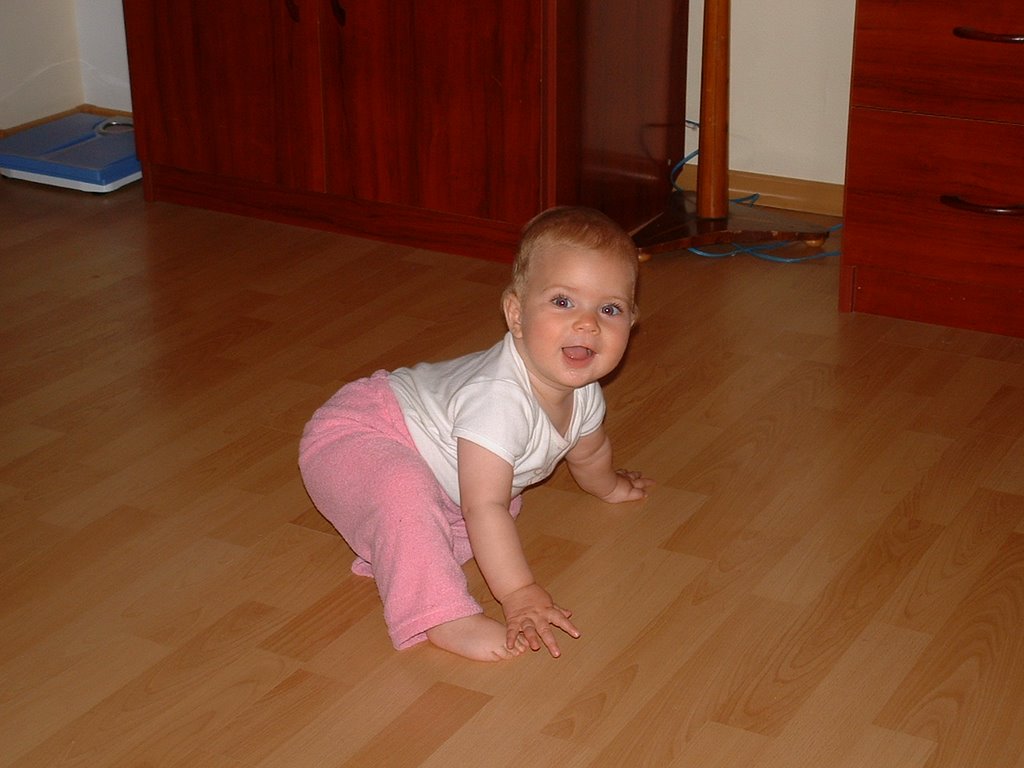
For no reason other than my own pride, here are a couple of recent pictures of Paula.

Updates

I am finally getting around to updating the sidebar on this blog with regional English language blogs (something I've been meaning to do for ages). If anyone reading would like to recommend/suggest any I might have missed, please let me know.

Wednesday, October 04, 2006

Irredentist

Today’s word of the day is Irredentist. It has absolutely nothing to do with the person who fixes your teeth.


ir•re•den•tist
n.
One who advocates the recovery of territory culturally or historically related to one's nation but now subject to a foreign government.
________________________________________
[Italian irredentista, from (Italia) irredenta, unredeemed (Italy), Italian-speaking areas subject to other countries; see irredenta.]
________________________________________
ir re•den tism n.
ir re•den tist adj.

The American Heritage® Dictionary of the English Language, Fourth Edition copyright ©2000 by Houghton Mifflin Company. Updated in 2003


As you can see it’s quite posh, and dead clever, and being able to use it (and use it correctly) bestows great kudos on the user. It has the added cachet of being derived from an Italian political movement, which obviously means the word has a certain style and élan.

Now the reason it has come to my attention is that I’ve recently found myself marveling open-mouthed at the behind-the-scenes pages of Wikipedia. When you look at something on Wikipedia, you see something akin to an encyclopedia entry, explaining and outlining a concept, person, place, or what have you. We all know that it’s edited by users and therefore you have to be a little bit careful with the information contained therein, but in general I reckon it’s a pretty good resource. However, when you look at an entry there, you may not have noticed the little tabs at the top of the page through which you can look at the history of a page and the discussion surrounding what’s gone into the entry. Here, for example, is the entry for Harghita County. Clicking on the tab marked “Discussion” will lead you into a strange nether world of pedantry, nerdiness and (in the case of all Wiki articles on places in the Hungarian speaking part of Romania) nationalism.

This is where I have encountered the words “irredentist” and “irredentism”. They are usually used as the last resort in an argument on a Wiki page, when nothing else makes sense, the loser will shriek something like “Well, I don’t care. It’s irredentism”. An example of something that is “irredentism” in this way is the alternate (ie Hungarian) spelling of the name Harghita as Hargita. Now the argument seems to go like this (and this is repeated all over Wikipedia articles for this region):
A: The county is Harghita. That’s the spelling recognized by the Romanian government.
B: Yes, it is, but the majority of the people living in the county spell it Hargita (since they are Hungarian)
A: Ah, but it’s a Romanian county – and it wasn’t even invented as a county until the 1960s so it has never existed as a Hungarian county
B: yes, but it has a Hungarian spelling which the population use because the county is named after a mountain (which has been there since before the 1960s)
A: But what does it add to the article to give it two different spellings? How is this useful?
B: Well, it’s supposed to be an encyclopedia right? Are we rationing knowledge/information now?
A: Well, I don’t care, as far as I’m concerned it’s irredentist.

Thus, in the hope of A, bringing the argument screeching to a halt and allowing him to walk away the victor for using a big word and stating opinion as fact. Obviously utter bollocks.

People like A, and I’m mentioning no names, but you can find some if you spend long enough looking through these dark-side-of-the-wikipedia pages, would have you believe that me calling my blog Csikszereda Musings is in fact irredentist. i.e. That I am concerned with returning Transylvania to Hungarian control, and that my decision to refer to the town in which I live as Csikszereda is proof of that. So, lest I be accused of irredentism, I would like to make it plain that I have no desire for Transylvania to be ruled from Budapest, and furthermore, know nobody who does (I suspect there are a few people in Hungary who advocate for it, but I’ve met no-one in Transylvania that way inclined). I just call this town Csikszereda because that’s what everyone else calls it here, because that’s what it’s called in their language. We all recognize that the Romanian name is Miercurea Ciuc, of course (a name which is directly derived from the Hungarian name), but frankly both names are equally valid. I, in short, am no form of dentist – either irre- or otherwise.

Now, this use of a word as an attempt to silence argument is not new. Those of us on the left are often rightly accused of throwing out the word “fascist” at anything we disagree with. Which is obviously just as bollocks as the use of irredentist for similar purposes. (Intriguingly, fascism is another word which has its origins in an Italian political movement. What is with Italy and these words?). The right has recently cottoned on to this “soundbite argument” style and has started throwing around the word “Islamofascist” in an attempt to lump wars on Arabs and other Muslims together with the war on Nazi Germany. It’s all bollocks.

Anyway, to sum up, arguing that Transylvania ought to be a part of Hungary = irredentist. Calling Miercurea Ciuc Csikszereda = not irredentist.

(I ought to point out that most of the people who edit and then discuss edits on Wikipedia seem to be perfectly normal reasonable individuals (if a tad obsessive and pedantic), and that indeed there is a refreshing amount of agreement between most Hungarian and Romanian editors. It’s just one or two mad ones. And if you thought the “discussion” pages were seriously manic, then try out the Mediation cabal pages. Blimey.)

Tuesday, October 03, 2006

Happening

Yesterday, I may have inadvertently led you to the conclusion that Csikszereda is an unexciting town in which nothing ever happens. (Actually it wasn't so much inadvertent as advertent). Well, I was having you on. Nothing could be further from the truth. Here are three things which have happened very recently which show, in clear and explicit tones, that this town is in fact, rocking, and is, perhaps, as insomniac as New York.

  1. We have celebrities: On Friday, I had lunch with the departing participants from my course, in the pleasant beergarden-like ambience of Gambrinus Csarda. At the next table, there was a bona fide celebrity. Now I appreciate that people who live in capital cities and the like are always seeing celebrities, but up here, they’re a bit of a rarity. This celebrity was none other than pneumatically-chested (ahem) “top model” and (sustained bout of fake coughing) “actress” Nicoleta Luciu. If you want to look her up on Google images, I’d suggest you don’t do it at work. [She was pointed out to me, I wouldn’t have recognized her. Honest.]

  2. We have Culture: I was idly watching Euronews yesterday, as you do, particularly when the “Agenda” section comes on. This involves them using up some time on a slow news day by highlighting a few art exhibitions going around Europe at the time. Suddenly I looked up from doing something or other, to see, to my utter shock, the words “Miercurea Ciuc” on the screen. Yes, that’s right. An exhibition here (specifically, the “Going Glocal project”, which is taking place at the Ko.Ke.M gallery) was featured on Euronews. Impressive huh? I must now go along to the gallery (it’s actually in the same block that we live in, so it ought not to be a major hassle)

  3. We have a successful professional sport team: Sport Club Miercurea Ciuc, our ice hockey team, and possibly the only thing that keeps many people going through the winter months, is, this year, participating in both the Romanian league and cup (as normal) and the Hungarian league and cup. Not sure how they’ll fit all the games in, but they’re so far doing very well in the Hungarian league, having played 6 won 5 (although 4 of those 6 games were against the weakest team, the other two, one of which was won was at the league’s strongest team). The Romanian season hasn’t begun yet.

Plus of course we have a consulate – and most Romanian towns cannot say the same. Bucharest obviously does, Cluj does, I’m sure. Timisoara might do, and possibly Sibiu and Constanta. But not many others. I don’t even think Brasov does. Hah!

So, Csikszereda – boring hick town stuck in the mountains, or happening cultural destination? You decide.

Monday, October 02, 2006

Small potatoes

The potatoes this year are very small. Very little else is talked about on the streets of Csikszereda this year.

“Oooh have you seen how small the potatoes are this year?”
“I know, it’s shocking isn’t it? I’ve never seen such small potatoes”
“They look like soil encrusted ball bearings”
“Or largish hailstones”
“I saw some the other day that could have been plums”
“Plums? They’re quite big. For this crop, I mean, since after all they’re very small this year”
Blah blah blah, etc and so on

I exaggerate slightly – while this is not exactly the world’s most exciting town, and is unlikely to make the shortlist in all but the most surreal “most exciting town” competitions – not ALL conversations are about potatoes. But, being one of Harghita county’s principle exports (along with mineral water, rocks, and Ciuc beer), potatoes and the quality of the annual crop are a fairly significant part of public discourse.

I believe, quite firmly, that the 2006 crop of miniature potatoes is yet another warning of the “End of Days” , and that it is directly mentioned in the book of Revelations:

“And lo, there shall come a time when the rise of the Antichrist will be heralded by a year of very small potatoes¹ and ye shall hear the veritable complaining of the peasantry whose livelihoods depend upon reasonably proportioned tubers. At this time of small potatoes, ye shall know the antichrist by his patronage of the “Star” of Bucharest and the fact that he is known by the number 666 ²”

So, we’ll soon all be taken up. Or not, depending on whether God reckons we’ve been good or not. Judgmental tosser.

Footnotes:
¹ There is some debate among scholars over the translation of this word from the original text, since “potatoes” weren’t discovered by the Judao-Christian world until Columbus went to the Americas. Some contend that the end of days will actually be heralded by a crop of very small turnips.
² The name “Gigi” can (in English) be rendered as “GG”. Placed together with the initial “b” it is clear that in certain fonts “GGb” is in fact the number of the beast. Coincidence? You be the judge.

Sütő András

Sütő András has died. He was, until last night, one of the most famous living Transylvanian Hungarians. To Hungarians he is a great playwright and novelist, who, through his work, highlighted the cause and charateristics of ethnic Hungarians living outside Hungary. To the outside world he is probably most remembered for being blinded in one eye by the Romanian nationalist peasant mob that was whipped up and bussed in to Targu Mures in 1990 to attack a Hungarian student demo. The mob attacked the offices of the Hungarian politcal association and attempted to kill Sütő - obviously they failed, but did instead manage to poke out one of his eyes. He always remained in Targu Mures/Marosvasarhely, rather than moving to Hungary.

Short biography.

And here is an obituary (the only English language one I can find at the moment using Google News)