Showing posts with label language. Show all posts

Friday, November 01, 2013

A 100 year old mirror

Recently, I started reading what seems to be widely regarded as "The Great Transylvanian Novel", which is Miklos Banffy's Transylvanian trilogy (or Banffy Miklos's if you prefer). Period literature is not really my thing, usually, and especially period literature which features as its main context the lives of aristocrats and the privileged.  But, so far, (I'm mid way through book 1) it's an absolutely cracking read. I'm - to my surprise, actually - really enjoying it.  And so many things are familiar to me, in a way which I could never have expected. (Which is precisely why everyone tells me that I shouldn't overlook such novels. So, I have been foolish.  As usual.)

So, anyway, I'm guessing I might write again on this subject as I devour the 3 books, but yesterday I came across a passage which was just so perfect I felt I had to share it.

The hero, Balint Abady (I'll just stick with the translated version's ordering of names rather than the original Hungarian), who is a count and a politician (and one assumes not a million miles from Banffy himself), is travelling on a train from Maros-Ludas (Luduș) to Kolozsvar (Cluj) where he meets a Romanian lawyer, Dr Aurel Timisan.  They start talking and...

It was all such nonsense: Romanians were Romanians and would remain so eternally, no matter what new names were invented for them. "Nobody expects anything else," said Balint, "but you must admit that the country in which you live has a right to demand that you learn its language!"

"Naturally, I'm not against that," said Timisan, and once again a barely perceptible mockery lurked in his smile, "That's to everyone's advantage. As you see I've learned it myself, even becoming a Doctor of Law at a Hungarian university and serving in the Hungarian army, both with tolerable success, though I say it myself. [...] "But you must admit, too," he went on, "that it is most unjust that the public notaries, high sheriffs, tax-collectors - indeed all public servants - are not obliged to speak the language of the people they serve. It is really absurd that the people cannot explain themselves in court in their own language, but they have to use an interpreter.  the Nationality Bill was supposed to grant us this...but of course it's been drawn up by Hungarians without us being consulted!"
This passage actually made me laugh out loud because I feel like I've had this conversation over and over, or overheard it time after time.  Except now of course, the roles are reversed, and Romanian and Hungarian have changed places. This part of the novel is set in the early part of he last century, around 1906 I believe.  100 years later and we have exactly the same conversations about more or less exactly the same things, just in reverse.  First time tragedy, second time farce?

Abady changes the subject at this point, and sounds a bit like a more erudite version of me..
"It's my view," he said, "that we should try and find the means to draw closer spiritually and economically.  here in Transylvania we are both at home. It is your country and it is my country. It is common ground to both of us. We could learn a great deal is we paid more attention to what really matters, and did not allow ourselves always to be sucked into the whirlpool of Budapest politics"
(Here you have to replace Budapest with Bucharest, but you knew that)

plus ça change, plus c'est la même chose

It's a great book.  I'd really recommend it.

Thursday, February 09, 2012

The Romanian Education System (3)


Finally, many months after starting this small series, I am ready to get to the third and last part of it - though obviously since I started it the education system here has had loads more crap piled upon it.  As of the day before yesterday there is yet another new education minister, but I'm not hopeful of positive change any time soon.
But I digress.  
The third area in which I encounter a massive problem with the Romanian education system is not an area which affects much of the country.  But it is certainly a huge issue here. 
This is to do with the teaching of Romanian in schools. Specifically the teaching of Romanian to those who don't speak Romanian as a mother tongue.  Which is most kids in Csikszereda, including my own daughter.  
Now before I start on my now customary rant, let me make it totally clear that I believe very strongly that all Romanian citizens should be able to speak Romanian. It seems to me more or less unarguable. But - the current system actually, I believe, makes it harder for people who don't speak Romanian as a first language to learn it than it should do.
First of all, let's clear up a semantic thing, partly because it irritates me, and partly because it will make it much easier to write the rest of this post. That is that kids who, say, speak Hungarian as a mother tongue, need to learn Romanian as a Second Language.  Clearly they are not learning Romanian as a foreign language (because it's obviously not a foreign language).  They are learning it as a second language.  Second, in this context, does not imply second class or second rate, merely a marker of the order in which the languages were learned. Kids in the UK or USA who are not native speakers of English learn English as a Second Language and nobody gets stressed about this terminology.  So, for my own sanity I will call it Romanian as a Second Language (RSL) here, rather than the convoluted phrase that is often used to try and avoid this which is something like Romanian for Romanian children who don't speak Romanian as a first language.  
Now for a large part of my adult life I was a language teacher. In fact at times I still teach English.  I do know a little bit about how language teaching and learning works, so unlike most of my usually ill informed posts this one is coming from a place of some actual knowledge. It may be the last time it happens, but we'll see.
The situation at the minute is that all children in the Romanian state education system study the same subjects to the same curriculum (there are some minor variations in subjects studied, especially in languages, but in general). This means that all children in Romania study Romanian in the same way. That is to say that children who speak Romanian as a first language study the same curriculum as those who study it as a second language. There is a certain desire born of nationalist head-in-the-sand-ism that we should close our eyes to the fact that in fact these two groups of children have different needs and are coming from a very different starting point.  If we treat them exactly the same, the logic seems to go, then they will all be good Romanian children.
But in fact, of course, the opposite happens. Kids who really should be learning RSL, end up finding themselves completely lost in a curriculum which is completely unsuitable for them. My daughter  is expected to read literature, which in many cases is not even modern Romanian, but is an archaic version of the language.  The grammar work she studies is heavy in metalanguage and light in practicality.  In short she is not taught Romanian as a tool  for a communication, but as a literary language to be examined. Which does, obviously, make some sense for most Romanian kids (though I'm not entirely convinced of the value to Romanian kids of reading Ion Creanga at the age of 12, myself, but that's by the by).  I've lost count of the times which I've come upon her crying because she just can't understand what she's supposed to be doing, each page of the novel takes her hours to read, and she beats herself up over the fact that she can't do what she shouldn't be expected to do.  And, she is one of the best in her class.  She is motivated and keen and actually is doing very well in Romanian, despite the system. I'm incredibly proud of her, and her language skills, but at times it's heartbreaking to watch.  
And it of course means that many kids who need RSL, are not learning Romanian well. At best they can learn to struggle through the exam system and not be completely held back by it, but they are not learning to use the language properly.  And surely the goal of this system should be that RSL kids leave school speaking Romanian very well and therefore being able to be full members of society.  This must be what would suit everyone. (Unless of course the goal is to actively disadvantage RSL kids - and it does disadvantage them as they have a much harder time in the national exam in Romanian at the end of the 12th grade for example, which in turn harms their overall grade, quite apart from harming their ability to succeed in one of the primary life skills that they need - the Romanian language)
(Actually at this point I should probably add that I am not alleging some nationalist conspiracy to keep the Hungarians and others back and deliberately make their lives difficult.  I genuinely think it is this way as a result of simple pigheadedness and stupidity)
To give another example of how this plays out: Some while back some friends who are from here but who moved to Hungary returned with their two children aged 11 and 13. Obviously having been brought up in Hungary the boys spoke no Romanian, but back here in Transylvania attending school they are of course studying Romanian. At a party a few months after they came back (at which I was present) the younger boy was asked by his mother to show us what he had learned at school that week. He then proceeded to recite the entirety of a fairly long Octavian Goga poem. He could recite it word for word, quite well, I'm told, but understood barely a word of it. Now it seems fairly clear that this is not good language teaching.
Obviously there are other side effects to this as well.  Not only does it fail to teach RSL kids Romanian successfully (which of course has a knock on effect of making their lives difficult and also failing to develop the potential of everyone), but it leads to a dislike of the language in general (after all it is the school subject which most makes the kids in question suffer). This is - in some cases - exacerbated by the nationalist feelings that they may be getting from their parents or classmates, and in turn exacerbates them.  All in all, the effects go beyond the academic achievement of the child in question, but actually can serve to cause even deeper rifts in society.
It's not that the Romanian education system is not good at teaching languages - these days most young people speak very good English for example, and many also speak French, German, Italian or a number of other languages.  It's just that the approaches and methodologies used in teaching those foreign languages are not allowed to be applied to teaching Romanian as a Second Language.

This change seems like such a no-brainer that one might wonder why it hasn't yet happened.  Indeed so much of a no-brainer is it that even Basescu, a noted no-brainer himself, has mentioned that he thinks it should be changed.  But yet, every year it is still the same. One might even have cause to wonder what the UDMR are actually doing with their time in government if they can't even influence a policy that is so clearly and insanely fucked up. 

Thursday, September 02, 2010

Greet Expectations

I'm going to go out on a limb here and suggest that there are very few places in the world where the act of greeting someone on the street is as complex and fraught with difficulties as here in Csikszereda.

Let's start with Hungarian, to get us going. Now in Hungarian there are many ways of greeting someone, many of which are entirely dependent on a perceived or actual relationship between greeter and greetee.

Informally, you can go with szia or szervusz, unless of course you are greeting more than one person, in which case it is sziasztok or szervusztok. Apparently szia is slightly more informal than szervusz, but this is not something I've ever really encountered. You can also, as I may have mentioned before, actually use hello.

However, even if you know the person, you have to be a little bit careful with such levels of informality, because saying it someone to whom you ought to be granting some form of respect (older people, VIPs, etc), could cause offense. Even if you don't reckon they've earned that respect. To an older woman, for example, you are supposed to go with Csókolom which is sufficiently respectful for that group. (However, I occasionally worry that if I offer a Csókolom to someone who is younger than me, or around the same age, or just marginally older, but who seems "obviously" older, I risk causing age related offence).

To an older man, or someone you don't really know (assuming they don't fall into the "older woman" category), you need to offer some form of good morning/day/evening etc. This would be jó reggelt (good morning) or, gussied up a bit, jó reggelt kívánok (I wish you good morning - it's not clear what else you might be doing with your "good morning" if you're not wishing it, but there you go). Others include jó napot (good day) and jó estét (good evening). OK, so far so good, but then you have to remember that what you might consider the morning is not necessarily the morning to a Hungarian (nor to a Romanian for that matter, but we'll come to that). Say jó reggelt at 11am, and you are looked at like you are mad. In villages it's even worse, because the morning very definitely seems to finish at 9am. A 9.15am jó reggelt would probably get you kicked out of the community for being a lazy good-for-nothing who didn't actually wake up at 4 to feed the chickens (or whatever it is that people do at 4am)

It's been 6 years now, and I still mix some of this stuff up. Yesterday I was going to pay the phone bill and saw someone I sort-of-half-knew, and offered a cheery szia. The moment it left my mouth I knew that this was almost certainly a jó napot situation and that I had erred. The really tricky thing is that if you are greeted first you don't necessarily respond in kind, like you do in English. Children (especially polite ones) tend to Csókolom all adults, and I may have inadvertently confused one or two kids in my early days here by offering the same greeting back.

OK, so that sums up the greeting challenges in Hungarian, but here of course there is another level of difficulty - the fact that some people you meet aren't actually Hungarian, but Romanian (this being Romania and all that). Thankfully, Romanian doesn't seem quite as complex as Hungarian in this regard. Here in Transylvania there is the use of szervusz (though I am sure it's not spelled like that by Romanians), but apparently that's only here, and not elsewhere in the country. Then there are the various good (insert period of day) greetings, in which like Hungarian, there is a "different" understanding of what constitutes "morning". I said bună dimineaţa (good morning) to two Romanians I met in England a couple of weeks ago (at about 11am) and they laughed as if I was an idiot, and said "Dimineaţa?" with heavy emphasis. You can just about get away with the bună bit on its own most of the time (you couldn't just say any more than you could just say "good" in English).

The extra level of challenge here is knowing who you should greet in Hungarian and who in Romanian. Obviously if you know them well, it's no issue, but sometimes you sort of half know someone, but can't actually remember what their first language is. There are two Romanian blokes who live in my building for example, but I am always confusing them with a Hungarian bloke who also lives there, and so I frequently guess wrong (and I never seem to learn).

The only one I always get right is my own slightly pathetic little rebellion against organised religion, whereby I always offer a cheery jó napot kívánok to any Orthodox priest I walk past on the street (knowing full well that he must be a Romanian), and a similarly breezy bună ziua to Catholic priests (knowing full well that they must be Hungarians). I like to think it throws them a little, and it makes me feel vaguely smug for a nanosecond, so that's a result in my mind.

Thursday, July 08, 2010

Words don't come easy

When Bill Bryson moved back to the US (to live not far up the road from me, in fact) he wrote a book of his experiences as a long time expat returning to his home country, called "I'm a Stranger Here Myself" (I think). Anyway, one of the most memorable bits for me was his comment that there were words that he wasn't sure of the American English for, having not needed those items when he was growing up (I think he left the US when he was 19). I don't have the book in front of me, so I can't vouch for this quote exactly, but the one that sticks in my mind was him going to a DIY shop (or Hardware store as it would have been) and asking "I need some of that stuff you fill holes in walls with. My wife's people call it Polyfilla". with the guy responding "Ah you mean spackle"

My problem is similar only at least Bryson had words which he knew in English, just in a different version of English. I have words which I only know in foreign languages. The first one of these to cross my consciousness was rucula, which was a delicious salad leaf I first encountered in Spain. Later I learned the Italian (rucola) and then arugula which I'm not even sure what language it is in. Finally I discovered that in English it is called "rocket", which frankly is a bloody stupid word. This comes about mostly because I am knocking on a bit and in my day fancy vegetables like rocket were not available in England. Salads had iceberg or cos lettuce in them, and that was your lot.

But there are also words which I still have no idea of in English. Yesterday we went out and picked some mushrooms and wild fruit, most of which I have no idea of what they are in English. The most commonly picked wild mushroom round here seems to be the rókagomba, which translates literally as "fox mushroom". I have no idea what it's called in English, though I am sure it's not fox mushroom. There are also the csirkelab gomba ("chicken leg mushroom" which to me looks a lot more like coral), the galambgomba (pigeon mushroom) and various other evocatively named edible mushrooms. Last night I had a delicious mushroom omelette made of fox and bear mushrooms (rokagomba and medvegomba).

We also picked a lot of szamoca - these are small wild fruits of the strawberry family. They may actually be known as wild strawberries in English, but I'm not sure. And a fair few afonya, which I do know because I used to pick then in England growing up (bilberries in case you're wondering. NOT blueberries as many dictionaries will tell you).

Away from food, like Bryson, I have some difficulty with some construction words too, mostly because I obviously have never done any construction/DIY work in England (I'd never done any anywhere to be honest until I moved here). However, for whatever reasons, it seems like most words used for such items here tend to be Romanian rather than Hungarian (I mean by everyone). So for example there is this material called gips carton (Everybody calls it that but it must be a Romanian word rather than a Hungarian one). I can't even describe what it is exactly, but it is a sort of board material that is not wood, but is strengthened in some way. The inner walls of our renovated barn are made of it. God only knows what the English is for it. There is also a kind of thin wood that you use for the walls of sheds and similar called (something like) lumberia (again that must be a Romanian word).

So if you ever see someone in a branch of Jewson or somewhere looking a bit lost and asking for some gips carton or lumberia, before idly speculating whether it would be possible to pick fox mushrooms in the woods over there, then it's probably me.

Thursday, March 11, 2010

Stupid quiz

A completely gratuitous and apropos-of-nothing-in-particular quiz for your Thursday pleasure.

Translate the following. What's the link?
  1. Öreg sonka
  2. Enterrer
  3. Casco
  4. Ficat piscină
  5. Schüren
  6. Lupi
  7. Novo castelo
  8. Mlýn zeď
  9. Okuma
  10. Zapad šunka
Note: I can not actually vouch for the perfection of many of these translations, but as far as I can tell they work.

Wednesday, December 02, 2009

An authentic must-read post

Spent the kind-of-semi-official-4-day-weekend* in Budapest, enjoying a weekend with Mrs H (and without children), and generally having a good time - drank hot wine in Vörösmarty tér at the Christmas market, had an afternoon in the opulent but faded Gellert baths, ate well, and saw various friends. All most agreeable.

(*It wasn't really a 4-day weekend, but as December 1st is a holiday here for Romania's national day, and as the government - not that there is a government at the moment- is forcing public sector workers to take 10 days unpaid holiday, most places used that lonely Monday as one of their 10 days, and gave it as a holiday too)

On the way back, we were in Ferihegy airport and there was a sign advertising the "authentic" Irish pub there in the terminal. Now, at what stage does the word authentic lose all of its meaning? And have we already reached that stage? This is an "authentic" Irish pub in an airport. In an airport in Hungary. Almost certainly with not a single Irish member of staff. That looked nothing like what I imagine a genuine Irish pub to look like (see below). Which didn't even sell Guinness. I mean honestly, there was nothing that could be called even vaguely authentic. It sold beer. I guess that's about it. I think I'm going to start carrying round a marker pen and use it to cross out/highlight any uses of the word authentic I see.


(Ken Wilson tells me that he once saw outside a shop in the US the following "Authentic Antiques - Direct from the Factory")

Here is a picture of absolutely appalling quality which I took of this authentic Irish boozer

After marvelling at this masterpiece of deception, I boarded the plane and became profoundly depressed reading the newspaper which contained news that Switzerland had adopted an openly racist measure following a referendum, that with the support of a few US fundamentalist christians, Uganda is about to introduce the death penalty for homosexuals, and the analysis of the upcoming climate change debate in Copenhagen which made it clear that it was almost certain that nothing will get solved there and that we will carrying on racing headlong towards the precipice. What kind of a fucked up world is this? Makes Romanian politics seems positively bright by comparison.

Tuesday, July 21, 2009

Cultural False Friends

You are probably already familiar with the ideas of cognates and false friends. Cognates are words which are related to each other in different languages. English and Romanian, for example, contain a fair few cognates, since Romanian is Latin based, and English has tons of Latin based stuff in it. English and Hungarian on the other hand have very very few cognates, because Hungarian is just bloody weird. (And because they have one of those academies which insists on creating new words for new things, they don't even have easy-to-grasp words for things like "The Internet" or what have you).

False friends, are words which you think are probably cognates, but turn out not to be. The most famous example of this is the Spanish word embarazada, which means pregnant (and not embarrassed as people tend to assume). Though my personal favourite is the Portuguese word constipação which actually means "a cold", and so (because I have a puerile mind) makes me imagine Portuguese tourists going to the chemists in the UK while on holiday and asking for medicine for their cold, and getting something else.

Hungarian to English has one or two false friends - trafik, for example, actually means kiosk or tobacconists (there must be a "My hovercraft is full of eels" joke I could squeeze in here, but I can't work out how). Akció, on the other hand, means "special offer" or "discount", and not anything like "action". (This is also a Hungarian/Romanian false friend, as you sometimes see shops here with signs in the window saying Akció/Acţiune, which makes the same error. A slightly ruder example is the Hungarian word Szakadék which means cliff or abyss, and nothing like how it sounds (which is more or less "suck-a-dick")

Between English and Romanian there are one or two which come up all the time - nervous being the most obvious. The Romanian word nervos actually means angry, and this causes people (not least me) a lot of confusion. I think the Romanian word mizerabil means something like filthy, which is also a tad confusing. Then of course there's the common menu item crap (fillet of crap, fried crap, grilled crap, etc).

But, I have come upon a new concept here, and that is the cultural false friend. There is a Romanian word imediat, which you hear very often. How long will it be? Imediat. When will you be finished? Imediat. When can I expect it? Imediat. Now, in theory, imediat is a cognate. It means, as you might expect, "immediately". It's just that in English, immediately means "right away", or "I'll drop everything and get it done right now". It doesn't really mean that in Romanian. It means something more like "soon-ish" or "when I get round to it", or "in a week or so". So, I've had to mentally redesignate it as a false friend, or otherwise it just gets too confusing, and more that that, it creates unreasonable expectations (for me).

Any other cultural false friends? Or even just amusing linguistic ones?

Friday, September 26, 2008

Aj em fajn tenks

The title to this post was taken from Bogi's school notebook (or copybook as it seems to be called). She is, you see, now learning English at school - being in the third grade - I think Romanian speaking children start learning English in the first grade, but those for whom Romanian is a second language start their language learning with Romanian (for obvious reasons) and add in English as a third language when they hit 9 years old.

Now, obviously this is a bit of a waste of time for her, since she speaks English - not perfectly, and she's not that good at writing it, since she learned it from conversing with me, and more recently reading books in it - but she definitely speaks it (and while her Romanian is coming along well, her English is much better). So, because there are no real options at that age, she has to sit in an English lesson for two hours a week which is way below her. But this is fine, and while I think she finds it a bit boring, it's not the end of the world.

But yesterday evening we were enjoying the things that she has had to write down as a student in this class. The teacher obviously takes English expressions and attempts to "translate" them phonetically into Hungarian so that the kids can read them and say them. Except that this doesn't really work very well, because many English sounds don't really exist in Hungarian (and vice versa). Aj em fajn tenks is a good example. (In case you haven't worked out what it says yet, it's the standard response to How are you?) Phoneticaly translating it back into English gives us something like "Oy em foin tenks". Now, Bogi assures us that she didn't put any accents on the A in Aj or fajn, which would have at least rendered those long I sounds fairly reasonably. Áj em fájn tenks would at least have been close-ish to I em fine tenks. But that still leaves the problem of what to do with the short A and the th. You see you can't come up with Hungarian phonetic spelling of either of them, because there isn't one. A short e in Hungarian sounds like a short e in English, not like a short a. A t in Hungarian sounds like a t in English, and nothing at all like a th. So, these children are being taught some fairly deeply flawed pronunciation from the get-go, which is not really a successful way of doing it, in my opinion. The e/a thing is probably something that we can all live with, but the t/th thing, and even more amusingly the v/w thing (the number one in Bogi's book is rendered as van) will I suspect stick with them for ever, and they may never actually be able to pronounce these things well.

Now I don't think that all people ought to pronounce things in some standard RP form (for a start you'd have to work out what the standard was), but there are certain sounds that really need to be used to make sense in the language (Some Hungarian sounds are difficult for me, but i'd rather attempt to say them as they should be said, than make up some anglicised version) And Bogi can pronounce th and w perfectly well, so it's clearly not beyond the capacity of a 9 year old to deal with unfamiliar sounds (and in fact, arguably, this is the best time for them to have to do it).

Anyway, it gave us all a laugh when we read through them and it promises to make English classes all the more fun for seeing what odd ways of rendering English the teacher will come up with next. And if you ever wonder why Hungarian speakers respond to your How are you? with Oi em foin tenks, it's not because they learned their English from the Irish community of Birmingham.

Thursday, May 17, 2007

Bilingual Stirrings

Paula is starting, slowly, one word at a time, to speak. She has had one or two words for a while now - one of her first words, for example, was to point very firmly at something which caught her eye and say “Né!”. This is the Hungarian word for “Look!” and sounds not unlike “Ni” - thus for a while she was very much the “baby who says ni”. But anyway, I digress.

So, post né! and a long drawn out, occasionally whiny A-ny-u-ka, she was being quite slow to utter things. This apparently is quite common in bilingual babies who are getting input in more than one language - they take longer to start using the words. She was up to speed with all the other developmental milestones which parenting websites offer up, but speaking was (and is) lagging a tad. But recently the words have started to come - there’s now a very definite “köszi” (thanks), and something which sounds like “this” but is very likely “tessek” (among other things, “here you are”), and a few others. But a couple of days ago we were standing (or I was standing, she was in my arms) at the kitchen window looking for dogs outside (She loves dogs. And pigeons. All animals probably, it’s just that in downtown Csikszereda, dogs and pigeons are broadly speaking the only obvious non human options). As we stood and looked, there round the corner came a dog. Quick as a flash, her arm extended, and her finger pointed quivering at this sight. “Look!” she cried excitedly. In English. Not only had she come up with her first recognisable English word, but she had correctly surmised that she needed to use it with me, and nobody else, and had managed to do that all in the split second of intense excitement at seeing yet another scruffy mongrel. The human brain is an amazing thing.

I’m not sure how long it will be before she learns that an English speaking cockerel goes “Cock-a-doodle-do”, since at present they very definitely say “Kukuriku”, which is what those odd magyar cocks say. (More animal noises in different languages can be found here).

Monday, May 14, 2007

Random links, tags, and swearing

While I think about all the things I should write about (the Basescu suspension, more on Autonomy, the Rosia Montana gold mine, blah blah etc etc and so on and so forth), I instead will fill in the morning with a couple of unrelated and trivial observations and links

Firstly, from this weekend's Guardian, a piece about tourism in the Saxon area of Transylvania, and more specifically the village of Viscri. It's actually the second article in two years about Viscri (here's the first) so someone in that small village must have some kind of hotline to the paper. It's all a bit suspicious if you ask me.

Ages ago I was tagged to write something about a favourite computer game. Since I rarely have time for computer games - the other day I managed to spend the day watching a DVD in small bite sized pieces while Paula slep fitfully in my arms, the first DVD/video/film I've watched for ages, such is the lack of actual time to do these things - I can't really comment on anything very modern, but I do remember playing Football Manager on the ZX Spectrum for hours and hours back in the day, and playing it on that link brought back one or two vague flashbacks of those far off days. You try telling kids today that computer games used to be issued on cassette and they won't believe you. Before that I remember that magazines used to print the BASIC code for you to type in your own games. None of this DVD stuck to the front cover nonsense. (Thanks to 200 percent for the link)

Romania got creamed in this weekend's Eurovision song contest, which I didn't watch, and I haven't heard the entry (of anyone I think) so god only knows if it was deserved or not.

And finally, for today, a great language resource - The Alternative Hungarian Dictionary, from which you, the non-Hungarian speaker, can learn useful expressions which will either endear you to Hungarians, or earn you a smack in the face. I am familiar with quite a few of them, including all of the ones which involve equine genitalia (a very popular swearing device in Hungarian, for some reason), and some which are not included at all, but quite a few were entirely new to me. My favourite, I think, being Paksi mogyoró, which literally means "hazelnut from the town of Paks", but idiomatically would best be translated in English as "clingon". The site suffers somewhat from not rendering accents well (the Romanian dictionary from the same site is almost unreadable, so poorly does it deal with diacritical marks).

Thursday, November 09, 2006

Language by committee

Romania, in common with many European countries, has some form of national academy which decides on how the Romanian language should develop. Spellings get changed, new words get certified as being acceptable for use, and I don't know what else. I am told for example that the word "sunt" which is the first person singular and third person plural conjugation of the verb "to be" (As in "Eu sunt un blogger") used to be spelled sînt. Now that sounds like a seriously big change. Just imagine if one day the word "am" changed to "om" or something. It'd throw everyone into confusion.

And in fact that confusion happens here, as I learned a couple of days ago. Now she is going to school, Bogi is learning Romanian, and comes home each day with lots of phrases to practice (which to her credit she does, walking round the house commenting on what she is doing at all moments in Romanian. It's cool. She'll be trilingual in about a year at this rate). So, anyway, a couple of days ago she comes home with the words she has to practice, one of which is the word for "scissors". Her mother instantly corrects her pronunciation. Bogi, indignantly, tells her that this is the way she learned it today. A glance at her note book tells Erika that not only does she have the incorrect pronunciation but also the incorrect spelling. Patiently she sits down to help her with the correct pronunciation (the teachers, too, speak Romanian as a second language, and so are not necessarily to be trusted as to being entirely correct). However, before she does that, she just looks it up in a dictionary to be on the safe side. And, lo and behold, scissors is one of those words that has had its spelling (and hence pronunciation) changed by the Romanian Academy. I've just looked it up, myself, and can tell you that "foarfece" is the currently known spelling. The old one is something like foarfaca (though I'm doing that from roughly transcribing a version I've only heard, so it could be way off).

We learned the next day while waiting at the school gates for her to come out, that this scene repeated across the town as angry second language Romanian speaking parents worried about their childrens' educations, reacted to their little ones coming home with patently wrong information, with tirades of extracurricular support, loudly voiced concern about the quality of the education their offspring were receiving, and then shamefaced climbdowns. It also spread beyond the parents, with Erika's entire office agog at the news that the word for scissors had changed without them knowing.

I'm guessing that this kind of thing must go on all the time - native speakers presumably keep track of these changes and, while the transition must be difficult, at least are aware that things have moved on, but non-native speakers learn the language one way and unless they hear otherwise will assume it to have remained roughly as it was. Which brings me to the question - why is it necessary to have these bodies of people in dusty rooms pronouncing on what the language is, and what changes are necessary? Romanian has one, Hungarian (I think) has one, French definitely has one, German (I also think) has one. English doesn't. Yet despite that dreadfully anarchic fact the language seems to survive and thrive. Why does there need to be this rigorous control of language in certain places rather than the laissez faire approach favoured by English? (Indeed, if there were such a thing as an English Academy they would probably not have allowed me to use the phrase "laissez faire" in that last sentence.) I really don't get this need for a committee to ascertain what words or spellings or grammatical constructions people should be using. Could anyone help me understand?

Monday, October 09, 2006

Cruising

Paula recently started cruising. No, no, that’s not what you’re thinking of, it’s something entirely different. It is the official term (I have learned) for that period when she (or any baby, to be honest) starts trying to pull herself to a standing position. She’s only actually been crawling properly for about a month, having spent some while attempting to crawl with her head on the floor as well as her four limbs (go on, try that, it’s dead tricky), and the teacher in me would like her to perfect that skill before moving onto something infinitely more complex, but you know, she won’t be told.

I have no idea why it’s called cruising though. It’s all very confusing. I had always assumed that the preferred holiday of blue-rinsed American over-70s was known as “Going on a cruise” rather than “Cruising” precisely to avoid the confusion around the activity described in the second, most commonly understood definition here. “What are you doing for your holidays this summer, Myrtle?” “O, Walt and I thought we’d do a spot of cruising”. I mean it would lead to endless confusion and suggestive double-entendres wouldn’t it? “I heard Walt and Myrtle are cruising this summer”, “Oh, I bet they are”. But, now, to my surprise, I learn that the word has been co-opted by the parent community to mean something entirely different. How I wish these words weren’t besmirched by their being used by these marginal societal groups, to mean something faintly unsavoury. Oh, for a simpler more innocent world, when cruising was picking people up in toilets and not something involving watching babies repeatedly fall on their arse.

Is nothing sacred? The next thing I’ll discover is that cottaging is a word also used to describe the infant practice of burping lightly and allowing a small pool of half digested milk to spill from the mouth and be deposited on ones (and ones parents’) clothes.

Thursday, July 27, 2006

A toast

I was thinking about what I could post to mark this blog's birthday (Csiki musings is two), and could think of nothing. So I thought to opt for an unusual sort of post about nothing in particular, but in an abnormal fashion. Your task, should you want to do so, is to work out what, in particular, is odd or unusual about this blog posting.

Two tours around our sun. A lot of words in that long pair of rotations. A lot of trash. A small amount of important or worthy posts, I trust. Mostly dross.

Anyway, what additional information can I impart, now that I am trying out this difficult task of inking an abnormal post in this way? Could I talk about Transylvania, again? About Romania or Hungary, or Romanians and Hungarians? Our holiday in Bulgaria? I think today I may shy away from such old topics and focus on an additional option.

And that topic, randomly, is flying. I am thinking of this topic today, as tomorrow I must fly, to Spain, to Catalunya in fact, and it will occupy most of my day. First driving to Coanda Airport (four hours), waiting for two hours, boarding, flying to Milan, waiting for two additional hours, boarding again, and finally flying to BCN (as it’s known in airport lingo). All in all a full day lost. But things start to look up – as 2007 looms (and all that that will bring about) so, too, do low cost flights. Wizz Air, to start with, in launching a flight from Hungary’s capital city to my in-laws’ town will significantly cut my to-airport-driving. In fact, in August our total family will fly to London Luton (round trip) from that handy Transylvanian town for an almost impossibly low sum. And things only look apt to pick up from this point.

OK, I’ll stop now, finish this painfully poor post, lift a glass to two anni of Csiki Musings, and toast to two additional such anni. Hasta manana.

Monday, May 08, 2006

Magyarisms

English has, I’m told, 6 words which come to us from Hungarian. One or two of these words are only used to illustrate Hungarian concepts or things – like goulash for example. The English version of goulash is, I suspect, somewhat un-goulashy, which is reflected in the fact that we have interpreted the word poorly too – the Hungarian pronunciation of gúlyas is in fact goo-yash, since that “ly” combo in Hungarian does not contain any "l" sound. English is not the only language that manages to mangle the word in this way though – Romanian also makes it sound like goulash by spelling it gulaş. Having a quick look on the web, it seems that there is some controversy about what a goulash actually is. Here is one bloke's opinion, for example.

The next one on our list of 6, is another food. Paprika. Now we tend to use it to describe the powdered pepper used to flavour dishes (such as the goulash for example), but in Hungarian it is used for fresh peppers too. The powder is called piros paprika (red paprika) which may leave you wondering what a red fresh pepper would be called. This is solved by the fact that Hungary and Hungarian speaking areas have a bewildering array of peppers, such that “red pepper” would not be a very helpful description anyway. There is the round red pepper for example, which is known as the paradicsom parika – the tomato pepper, and the long one, the not quite as long one, the fatter one, and many others beside. I usually just point.

There are a couple of military ones – hussar and sabre. Not quite sure how they are spelled and pronounced in Hungarian, but I presume hussar is more like huszar. Why are hussars so often gay, by the way? I have no idea. You’d think being cavalry soldiers, they’d pretty much be cannon fodder, and not especially gay at all. But you never hear of the glum hussar do you?

Two left, and the first is coach. Not coach in the sense of trainer, but in the sense of vehicle. Apparently coaches (horse drawn ones I’m guessing) originated in the Hungarian town of Kocs (pronounced fairly similarly to coach). Thus in Hungarian a coach (and these days a car) is known as a kocsi (from Kocs), and a driver/coachman as Kocsis (hence Erika’s family name, and that of the ever-so-slightly more famous Kocsis, Sandor of the Magnificent Magyar 1950s football team).

Finally, biro. The humble ball point pen, named after its inventor Laszlo Biro, or more properly, Bíró László. Another Hungarian word we manage to mispronounce, since it should be more like beer-o. And that’s about it, as far as I know. If you know of any others, please let me know.

As far as I know there are no specifically Romanian words in English, but since Romanian is derived from Latin, there are an awful lot of words that exist in both languages.

Thursday, May 04, 2006

May Be Cold

April was very springlike and warm. May, so far, has been cold - at least here, May 1st, we celebrated international workers day in Marosvasarhely which was much nicer - this morning that little thing over to the right showed the temperature at 6am as being -3. In May. It's not right I tell you.

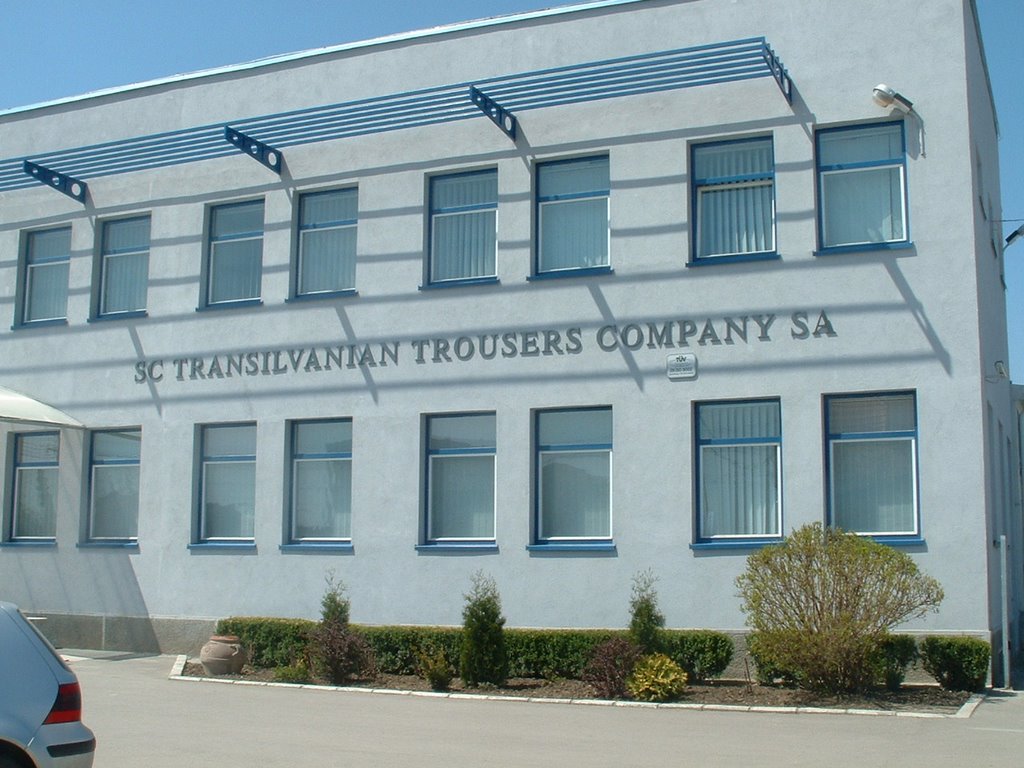
Meanwhile, a picture:


It took me a while to work out just what was wrong with the name "Transilvanian Trousers Company", until I realised that even though as a noun trousers is always rendered in the plural, as an adjective (as it is here) the word is trouser (as in trouser leg, trouser pocket, etc). Shame really, because I imagine Transilvanian Trousers could sweep the entire world with their ineffable coolness.

Tuesday, May 02, 2006

Romanian Accent

Romanians are very cavalier with their accents. By accents here, I mean not regionally diverse ways of speaking, but diacritical marks on letters to identify pronunciation differences. There are a lot of such marks in Romanian from ă to ţ and beyond. However, they are frequently omitted in written versions of the language, which is most confusing to the foreigner.

A few days ago, for example, I wrote a post entitled Happy Paste. Now “Paste” was the way I had seen the Romanian word for Easter written, and it amused me that it was paste. But I also knew that it was pronounced not “paste” as the English word, but Pash-tay (more or less), and so it began to dawn on me that it was probably actually spelt “Paşte”. This turned out to be the case. For another example, I drove this weekend to my in-laws house in the town whose Romanian name is Târgu-Mureş. Now on road signs it is normally written as Targu Mures (or sometimes abbreviated as Tg Mures), which is not at all how it is pronounced. That a with a little hat is prounounced something like an uh, not like an a at all. It’s turgu muresh (more or less). (Incidentally, just to confuse things further, it is also sometimes spelled Tîrgu-Mureş, with that be-hatted “i” being seen these days as a Stalinist letter which is no longer welcome. I’m not quite sure what a Stalinist letter is, but maybe it launched some pogroms or something.)

When you sit down in a restaurant and peruse a menu, and happen upon something you’d like to try but are not sure of the pronunciation of, you often have to guess at the correct spelling (and hence pronunciation), since menus appear to be a particularly accent free zone. It’s all very lackadaisical. I’m sure there must be examples of Romanian words that when the accents are left off mean something entirely different, such that when you think you are ordering a veal cutlet, say, you are actually asking for a large consignment of balloons, or some such humorous error.

Contrast this with Hungarian which is obsessive about its accents. Every day I fret and worry over the fact that I have called this blog Csikszereda Musings, a heinous spelling error for it really ought to be Csíkszereda Musings, with that accented “i” making all the difference. Well, to be honest I barely give it a moment’s thought, but I am aware that it is wrong. And it is, in effect, a spelling error. I presume not including accents in Romanian is also a spelling error, just that no-one seems to care. There must be Romanians who bemoan the laziness of printers and sign makers and constantly bang on at anyone who’ll listen about how the country’s going to the dogs, and how education isn’t what it used to be, but they (the possibly mythical people I’ve just invented) don’t seem to be having any impact.

Friday, April 28, 2006

Nasal Octopus

This has been a bad couple of weeks healthwise. Bogi came down with mumps (conveniently "mumpsz" in Hungarian) while I was away. This weekend, having sat out the requisite two weeks at home we noticed that she was not hearing very well. A visit to the ENT doctor on Monday confirmed that there was a problem - that she had a large octopus in her nose. So yesterday she went to have it surgically removed (obviously having an octopus in your nose is not especially healthy nor does it make it easy to breathe). All is well now, though and there are no more octopi or any other form of squid or cuttlefish clogging up her nasal passages as far as we know.

OK, OK, it wasn't actually an octopus. It was a polyp. However, the Hungarian word for octopus and the Hungarian word for polyp are one and the same (polip). So, like a true dad I have been amusing myself all week referring to it as an octopus. In my defence, it has made her laugh too, and helped her reach the operation with at least a couple of laughs to punctuate the pervading sense of fear.

She now has some spots which may or may not be the onset of rubella, another childhood disease which is also very popular at the moment in Csikszereda. Rubella when I was growing up was the best disease going - a week off school with no ill effects barring a couple of non-irritating spots. Of course in those days rubella was called German Measles for reasons I'm not sure of. Was it like Spanish flu in that it seemingly originated in Germany? Or were there more xenophobic reasons? Perhaps it was seen as very efficient form of measles - in and out in a few days without causing much fuss. Who knows? In other etymology-of-spotty-childhood-illnesses, chicken pox may be so called because it's like a rubbish version of small pox (see also "chicken feed") or because the spots look like chick peas. Not like any chick peas I've ever eaten, I have to say.

To top that off, I have a raging flu, though not of the avian variety. (Although I learned recently that all strains of flu originated in birds). Still, such is life.

Falling Star

Last night, contrary to my usual form, I found myself cheering on an English club in European competition (It's not unheard of, but it's fairly rare. I certainly won't be doing it in the upcoming Champion's League final). This is because of my overriding hatred of Steaua - and especially Gigi Becali. However, I had been slightly swept up by the seeming unitedness of the nation behind them (though this may have been a media invention) and thought it might be nice if they got to the final (and then got humiliatingly thrashed).

At half past ten Romania time last night, the game was all over. Steaua were three nil up on aggregate (effectively 3½-0 up because they had scored away goals) and there was only an hour left to play. At half time, even though Middlesboro had pulled one back, there was actually a discussion of the possibility that Steaua would get to play Barcelona in the European Super Cup final, and so relive the EC final of 1986. I thought that it was a bit premature, though I did assume that they would at least get to the UEFA Cup final.

The rest, as they say, is history. A stunning fightback by Middlesboro (for the second time in two rounds), and Steaua crashed out at the death, beaten 4-2 on the night. I was happy and still buzzing from seeing such an incredible game of football. But then as I flicked round the TV channels, the shock and dismay of everyone told its own story. This was a match that a lot of Romania wanted Steaua to win so they could represent the nation on a European stage. I don't really understand that level of national feeling for a club side (I'll be very very happy if both Arsenal and Middlesboro lose the two finals to come), but I could see that it was there. I'm sure there were hardcore Dinamo and Rapid fans who were happy that Steaua had lost, but most of the country it seems was shell shocked. I started feeling sorry for those Romanians who had willed the team on and seen them crash out in such unbelievable circumstances, so close to the finish line. As channel after channel wheeled their best pundits on to try and make sense of this national calamity, I began to wish that Steaua had indeed clung on to get to the final.

Then one channel cut to live footage of Gigi Becali leaving the stadium. He was so gaunt, so haggard, so white, and for the first time ever didn't look like he was enjoying being on TV, and in fact remained tight lipped and silent. He looked utterly broken and almost like he was about to burst into tears. At that point my heart lifted and my spirit soared and I remembered why I wanted Middlesboro to win in the first place. Grazie mille, Maccarone.

Sorry Romania - you deserve to have something to cheer, but not led by that cretinous oaf. Rapid in the final? Now that would have really been great.

Friday, April 21, 2006

Happy Paste

Today is Good Friday according to the Orthodox calendar, and hence part of paste. Paste is the Romanian word for Easter. I don't know if today is referred to as "Good" Friday by Romanians, or something else, as all I have seen is various invocations to enjoy my paste. Obviously paste (or Húsvét as it's known in Hungarian) was last week here, so it's one of those odd days which may or may not be a holiday. Anyway, I'd like to wish all my Romanian readers a happy Paste.

I was intrigued to find out the etymology of the word Húsvét, but have so far drawn a blank. My interest lies in the fact that the first syllable Hús is the Hungarian word for meat, and I wondered if Húsvét was a kind of celebration of the end of Lent, which would have amused me a lot, since I've noticed that the beginning of lent is often marked by massive blowouts which doesn't seem to fit in with the whole spirituality of the thing. However, I can't find out what Húsvét might mean. It did lead me into a discovery that "easter" is derived from the same root as "oestrogen", though, which I found vaguely interesting (it's all about springtime and fertility y'see). Paste, like similar words in various other Latin-based languages is taken from Passover, which at least makes sense.

Someone the other day asked me which European countries were orthodox, which, by a convoluted mental process led me to a realisation that all European countries which don't use the Latin alphabet are Orthodox Christian, and all the ones that do are not. With only one exception to this rule - Romania. Fascinating huh? (Well, it's actually two because there's Moldova too, but that's just decaffeinated Romania, so it doesn't really ruin this enthralling piece of information). Feel free to use this factoid down the pub next time you have a gap to fill in the conversation. I won't ask for any money.

Sunday, March 05, 2006

Heavy Tools

There has been a growing tendency in Csikszereda to name shops and other businesses in English. I was told that this was because it avoided the dilemma of using both Romanian and Hungarian. You see, if your shop has a Hungarian name, you also have to use the Romanian one, and vice versa – all üzlets are also magazins, and all restaurants are also vendéglõs. You can get around this limitation by using English or some other non-local language, and negate the need to translate anything.

However, I suspect that many of the new places, such as the “Office 1 Superstore” are actually chains that exist beyond the limits of Harghita County, and are thus named in English purely because it’s fashionable and modern and westward looking and all that. A new restaurant (or “Restaurant & Pizza” as it has cunningly labeled itself) has just opened on Petofi street, called “Bandido’s”, thus being fantastically international. A Spanish word with an English grammatical form taken from German (that ‘s bit, otherwise known as the saxon genitive). I’m hoping it serves high quality Mexican food, but I strongly suspect it will be pizza, pasta, burgers, csirke paprikas and mamaliga, and so merely add to the number of restaurants serving “international food” with some Hungarian and Romanian options thrown in to appease the local palates.

This Anglicization does lead to some odd names though. A few weeks ago, for example, a clothes shop opened in the middle of town called “Heavy Tools Clothing Division”. This too, must be a chain of sorts since it is way too fancy looking to be purely a Csiki business. A mischievous part of me would really like to go in and tell the manager what slang meaning “tool” has.

March 1st

An English friend who is married to a Romanian woman sent me a message on March 1st to remind me that it was Marţişor. Marţişor is the first of March, and functions as a kind of Romanian Valentine's Day, when men give little red and white brooches to the women they know. He was anxious that I should be reminded so that I wouldn't commit the ultimate faux-pas of not giving my loved ones these tokens of my affection. I had to admit I'd never heard of it so I checked with Erika, who informed me that it's a Romanian thing and Hungarians don't do it. Which let me off the hook, but made me imagine that it must be hell for Romanian teenage boys going out with Hungarian girls (or just hoping to be noticed by them). If you give the subject of your attention a Marţişor brooch, you just know she's going to turn around and tell you she's not Romanian and she doesn't do that (thus crushing you, her emotionally fragile suitor). If you don't, she's going to ask you why you didn't and don't you love her and tell you I'm sorry it's over (ditto). It's difficult enough being a teenage boy and knowing that you will never understand how girls' minds work, without throwing in an added inter-cultural counndrum.

Wednesday, February 22, 2006

Expat musings

What is an expat? And, am I one? I did after all, get nominated for a "best expat blog" award. These thoughts came to me this weekend as I found myself in a workshop attended by some members of Bucharest’s “expat community” and some Romanians – mostly, like me, from outside the capital. I didn’t exactly feel a part of either group, but felt I had more in common with the latter. And on this evidence I’m glad that I don’t have an expat community so I don’t get to listen to whining complaints all day about how much Bucharest/Romania sucks.

This is not to say that I haven’t been in such communities before (though I have tended to distance myself from the “I hate this country” brigade), and I understand the bond that people have when they’ve uprooted themselves and come to live in a foreign country, had to deal with the same bureaucratic quirks, looked for apartments etc. It’s natural that these communities are formed and start feeding off each others’ irritation with the fact that Romania is different from wherever they’ve come. But it does look odd, at best, from the outside (as I felt I was on Sunday).

So, what is an expat? In its simplest definition it is “A person living in a foreign country”, which definitely makes me one. But in itself that definition doesn’t really sum up the way the word is used. Indian immigrants living in the UK, for example, are never referred to as expats. By the same token, Israel has managed in its own inimitable way to create a bunch of expats out of people who have lived in the same place (East Jerusalem) all their lives and have just ended up being victims of a de facto annexation (it’s true, the Palestinians of East Jerusalem are regarded as being from the West Bank and only have resident alien status in the place they were born – even if they have lived in the same house all their lives.)

So, if this definition doesn’t work, what does? The Wikipedia entry, has it that there is a difference between an expat and an immigrant, that “immigrants (for the most part) commit themselves to becoming a part of their country of residence, whereas expatriates are usually only temporarily placed in the host country and most of the time plan on returning to their home country” Now I have no plans of returning to my home country. I’ve been out of it since 1988, and see no reason to go and live there now. But likewise, I’m not intending to take up Romanian citizenship any time soon either. It’s perfectly possible that I will live the rest of my days in Transylvania, but it’s also possible that we will move on and live somewhere else. So, I’m not entirely sure if I see my place in that definition.

In the way I’ve heard it used, it tends to refer to someone from a wealthy country living (however temporarily) in a less wealthy one. When I lived in the US*, the word expat didn’t really come up. In the Federated States of Micronesia, or in Thailand it was clear that I was one. Here in Romania I guess I am one, although absent a “community” of expats it feels a lot different. It’s almost as if to be an expat you have to hunt in packs. Would I have been more likely to have gained Expat status in the US if I’d lived in Florida or Southern California, where there are loads of Brits, rather than small town Vermont?
(*Note cunning reference back to Wikipedia article)

To me, also, it has a slightly negative connotation, conjuring up, as it does, the people who sit around the pool at the British Club, Abu Dhabi, complaining about their maids, or the anglo population of the Costa Del Sol, eating fish and chips and watching Sky News . Immigrant doesn’t have the same negative connotation (except for extreme right wing Daily Mail readers, to whom immigrant is code for all the racist drivel they want to unload but can’t due to the terrible restrictions of “political correctness”)

But there have always been gradations of meaning to describe migrants. The people who used to be refugees are now called “Asylum Seekers” at least in the British press. This cunningly distracts attention away from the situation they are fleeing and puts the emphasis on the country in which they are seeking refuge. With the additional benefit to the anti-immigration brigade of including the word “asylum” which conjures up subconscious thoughts of mental patients. And then of course there is “emigré” a term which seems only ever to refer to Russians, but which apparently means “One who has left a native country, especially for political reasons” according to the dictionary. Which makes me an emigré since I first left the UK to get away from Thatcher (and, obviously, the weather). Then there is “sojourner” which is someone living somewhere temporarily. And of course, diaspora, which until recently I’d only heard in reference to Jews, but then saw something about the Romanian diaspora not so long ago. Does this make me part of the British diaspora?

Personally, I think I’m going to self-define as an emigrant. Romania is my tenth country of residence, and I think it’s more relevant that I left my home country than exactly where it is I have settled, and for how long. All, I can really say is that I’m glad I’m not an expat, or, more accurately, I’m glad I’m not the expat I once was.